Summary of the Announcement
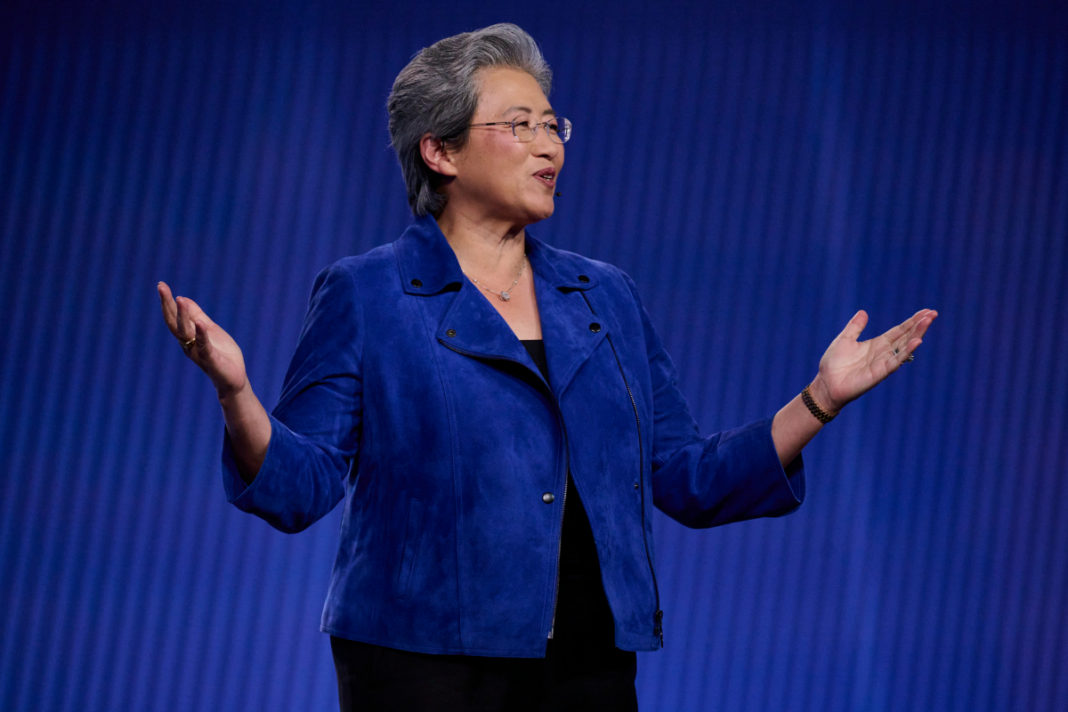
Chipmaker AMD has unveiled its latest innovation aimed at rival Nvidia: a cutting-edge rack-scale system aptly named Helios, engineered to cater to the computational demands of the largest AI laboratories worldwide. At the recent Advancing AI conference in San Francisco, which saw a full house, AMD’s Chair and CEO, Dr. Lisa Su, introduced Helios alongside a roster of initial clients, including tech giant Microsoft. The shipment of these advanced systems is anticipated later this year.
Helios is designed to consolidate multiple processors into a single, high-capacity unit specifically for data centers, enhancing the training and execution of AI models and other intensive computational tasks. Dr. Su highlighted Helios as the industry’s “highest-performance AI rack,” emphasizing its capability to manage extensive scale operations for demanding AI models. The system is poised to be adopted by leading AI firms operating at gigawatt capacity.
Why it Matters
The introduction of AMD’s Helios represents a significant shift in the competitive landscape of the AI hardware market, traditionally dominated by Nvidia’s Vera Rubin and Grace Blackwell systems. With performance benchmarks indicating that Helios outperforms many of its rivals, this development not only bolsters AMD’s position as a major player in the industry but also sets the stage for a more competitive tech ecosystem overall. Furthermore, Dr. Su noted that the demand for AI-specific chips is set to rise dramatically, with projections estimating that by 2030, the AI accelerator market could soar to approximately $1.4 trillion, paralleling the current scale of the semiconductor market.
This advancement underscores a broader trend towards specialized computing solutions that cater to the exponential growth in AI technologies, particularly as the world increasingly engages with machine learning applications across various sectors.
Impact on Residents, Businesses, or Visitors
The deployment of the Helios system is expected to have far-reaching effects on local enterprises and the broader community. For businesses invested in or reliant on AI technologies, such as those in data analysis or application development, the enhanced computational power provided by Helios could streamline operations and enable more sophisticated innovations. Residents could benefit indirectly through job creation and technological advancements that stem from increased investment in the local digital economy.
Moreover, for visitors and holidaymakers, the implications of this technology could manifest in enhanced digital services, improved online accessibility, and more robust tourism-related applications that leverage AI for personalized experiences and efficient service delivery.
Municipality Affected
All Municipalities / Archipelago-wide. The launch of Helios has potential ramifications across the entire Canary Islands archipelago. Local businesses that integrate AI solutions, including tourism and real estate sectors, stand to gain significantly. As AMD’s technology is adopted by key players in AI, the advancements in computing will ripple through regional operations, enhancing local infrastructure and service offerings.
Related Projects or Previous Developments
This announcement builds on AMD’s ongoing efforts to push boundaries in the tech space, following previous innovations such as the upcoming Venice-X CPU, which is designed for high-performance computing and scheduled for launch in 2027. Furthermore, partnerships with companies like Anthropic illustrate AMD’s commitment to supporting the evolving landscape of AI-centric technologies, highlighting a trajectory of innovation that aligns closely with the global advancements in artificial intelligence.
Internal Links
[placeholder_internal_links]
SEO Title and Metadata
SEO Title: AMD Unveils Helios: A Game-Changer for AI Computation
Meta Description: Discover how AMD’s Helios system is set to revolutionize AI processing in the Canary Islands. Learn more about its impact on local businesses and innovation!