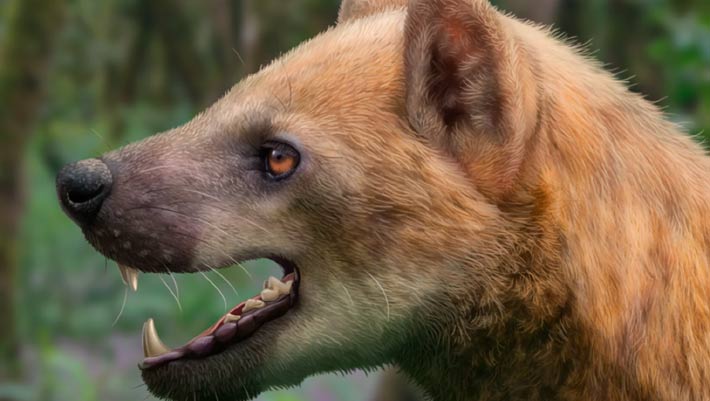
Discovery of a New Species: Paludocyon moyasolai
Paleontologists have made an exciting discovery in the Vallès-Penedès Basin near Barcelona, Spain, identifying a previously unknown species of amphicyonid, commonly referred to as bear-dogs. This new species, named Paludocyon moyasolai, sheds light on the diversity and evolution of these fascinating carnivorous mammals that roamed the Earth millions of years ago.
The Fossil Site and Specimens
The discovery was made at a rich fossil site known as els Casots, where two specimens of Paludocyon moyasolai were unearthed. The fossils include a well-preserved partial skull, complete with most of its teeth, and an isolated lower molar found separately. These specimens are now housed at the Institut Català de Paleontologia Miquel Crusafont in Sabadell, Spain, where they will be studied further.
A Glimpse into the Past
Paludocyon moyasolai lived during the Middle Miocene epoch, approximately 15.9 million years ago. At that time, the landscape was vastly different, characterized by warm, forested areas interspersed with shallow lakes. This environment likely provided a rich habitat for various species, including the bear-dogs, which were significant predators in their ecosystems.
Understanding Bear-Dogs
The amphicyonids, or bear-dogs, are an extinct family of carnivorous mammals that exhibited features reminiscent of both modern bears and dogs. However, they are neither; rather, they represent a unique evolutionary branch. Dr. Jorge Morales from the Museo Nacional de Ciencias Naturales-CSIC and his colleagues note that amphicyonids were crucial components of carnivoran assemblages across North America and Eurasia throughout much of the Cenozoic Era.
Evolutionary Insights
The evolutionary history of amphicyonids is complex. Recent studies suggest a North American origin for the family, supported by a more complete Paleogene record in North America compared to Western Europe and Asia. In Africa, the oldest known records of amphicyonids date back to the Early Miocene, persisting until the Late Miocene.
Distinctive Features of Paludocyon moyasolai
What sets Paludocyon moyasolai apart from its relatives are its unique molar teeth proportions. Specifically, its second upper molar is broader than the first, and its third upper molar is exceptionally large and well-developed. These distinctive traits have not been observed in other known members of the genus Paludocyon, making this species particularly intriguing to researchers.
Phylogenetic Analysis
To understand where Paludocyon moyasolai fits within the evolutionary tree, Dr. Morales and his team conducted a phylogenetic analysis comparing its teeth with those of related species from Europe and North America. Their findings suggest that this new species represents the earliest branch of the Paludocyon genus, positioning it as one of the most primitive known members of the group.
The Paraphyletic Nature of Cynelos
The analysis also revealed that the long-recognized genus Cynelos is paraphyletic, meaning its members do not all share a single common ancestor exclusive to the group. This raises questions about the classification of three North American species currently assigned to Cynelos. Interestingly, these species appear to be closer to Paludocyon than to their European counterparts, suggesting they may have evolved independently from different ancestral lines.
Implications of the Discovery
The discovery of Paludocyon moyasolai not only enriches our understanding of the amphicyonids but also challenges existing classifications within the group. The research indicates a distant relationship between European Cynelos species and the Paludocyon clade, justifying their classification as distinct genera. This finding opens new avenues for exploring the evolutionary pathways of these ancient carnivores.
Publication and Future Research
The findings of this significant discovery are detailed in a paper published in the Journal of Mammalian Evolution. As researchers continue to study the fossils and their implications, the story of Paludocyon moyasolai will undoubtedly contribute to our understanding of prehistoric ecosystems and the evolutionary history of carnivorous mammals.
This remarkable discovery not only highlights the rich paleontological heritage of Spain but also emphasizes the ongoing importance of fossil research in uncovering the mysteries of our planet’s biological past.