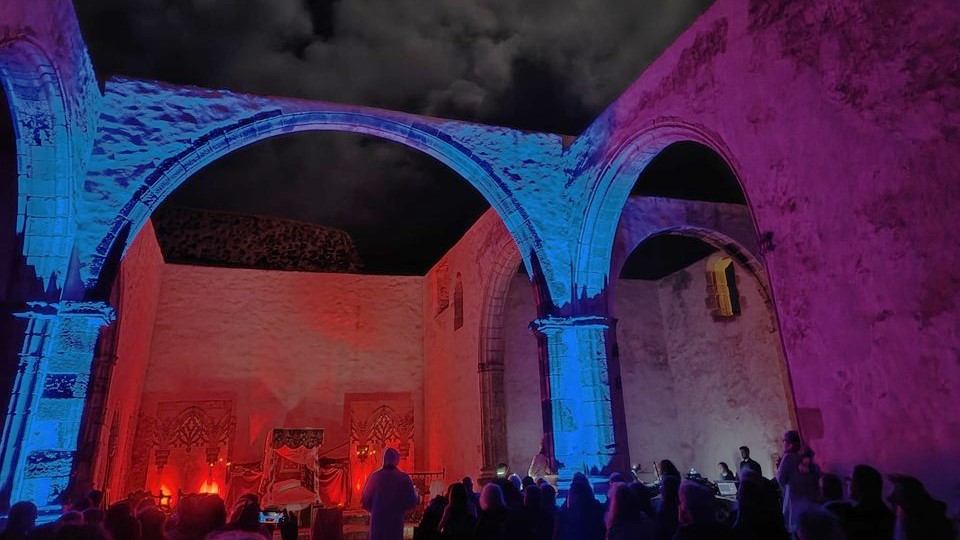
The photograph provided to Radio Sintonía Fuerteventura by history professor
Carmelo Torres offers a glimpse into the past, showcasing the
once-grand Iglesia de San Sebastián, located until 1957 in Vega de Río Palmas, within the municipality of Betancuria.
Elders from Fuerteventura fondly recall the San Sebastián chapel, depicting it as a structure with crumbling walls
and an absent roof. It stood behind the old unitarian school of La Vega, in an area that has since made way for
the cement of a sports court.
Torres noted in an interview that “the reasons behind the building’s demolition in 1957 remain unclear;
there are no documents to substantiate the cause.” He theorizes that the impoverished conditions on the island
during that time made the reconstruction of such a religious edifice impractical.
Historic Roots: Pre-1550
According to Torres, there are indications that the Iglesia de San Sebastián predates 1550; however, much of the
documentation was lost during the Berber attacks of 1593. Initially, it is believed to have been a small structure
that gradually expanded over the years, eventually evolving into a typical church of Fuerteventura, characterized by
a gabled roof, a single nave, and a distinct presbytery. As highlighted in the photograph, Torres describes its
“Renaissance-style portal, constructed from well-cut stone and closely resembling the façade of the mother church
in Betancuria.”
A Pattern of Loss: Up to Nine Missing Religious Structures
The fate of the long-lost Iglesia de San Sebastián was not an isolated incident. Torres mentions that as many as nine
religious buildings have disappeared from the municipality of Betancuria alone, including the churches of Santa Catalina
and Santa Lucía.
For those interested in delving deeper into this rich historical narrative, further insights can be found through
the following link: