Fuerteventura’s Emerging Startup Scene: A New Horizon for Entrepreneurs
Subheadline: Innovative ventures are redefining Fuerteventura’s economic landscape, offering a beacon of opportunity for local and international entrepreneurs.
Fuerteventura, renowned for its stunning beaches and year-round sunshine, is emerging as an unlikely hotspot for entrepreneurs and startups. With its strategic location in the Canary Islands and a supportive business environment, the island is attracting a growing number of innovative ventures. This shift is not merely a trend but a transformative movement that promises to bolster the local economy and diversify its offerings beyond tourism.
Government initiatives and local resources are playing a pivotal role in nurturing this entrepreneurial spirit. Funding programs and mentorship opportunities are readily available, guiding nascent businesses through the complexities of startup life. Moreover, the island’s community is becoming increasingly interconnected, fostering collaboration between startups across various sectors. This ecosystem not only helps to mitigate the common challenges faced by new businesses but also encourages knowledge sharing and innovation.
As Fuerteventura positions itself on the map of thriving startup locales, it is essential for local entrepreneurs to leverage the unique advantages this island offers. The combination of pristine natural beauty, a culturally rich environment, and a burgeoning startup network creates a compelling case for investment and growth. With a collaborative community and supportive infrastructure, the potential for impactful businesses is limitless.
Source: Gobierno de Canarias.
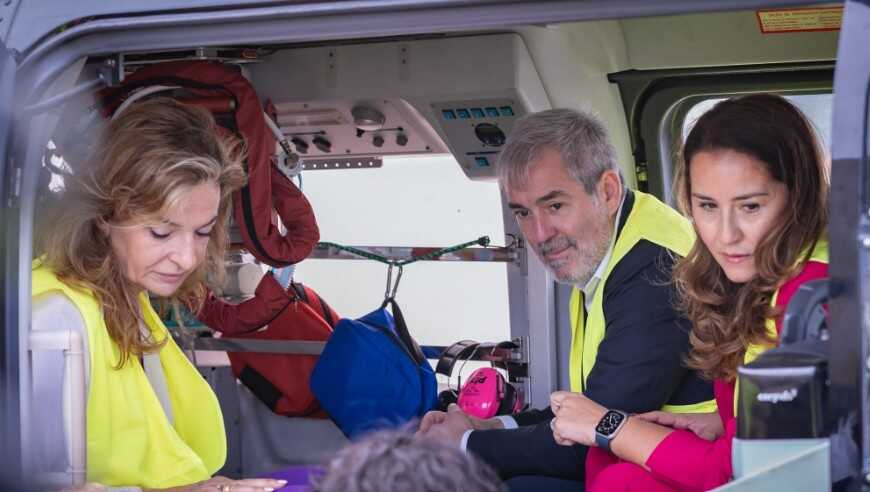
The new fleet of medical helicopters is presented in Fuerteventura The Government of the Canary Islands presented this Monday in Fuerteventura the new fleet of medical helicopters of the Canary Islands Emergency Service (SUC), attached to the public company Management of Services for Health and Safety in the Canary Islands (GSC) and dependent on the Ministry of Health of the Government of the Canary Islands. The event was attended by the president of the Canary Islands, Fernando Clavijo, the counselors of Health and Territorial Policy and Emergencies, Esther Monzón and Manuel Miranda, respectively, as well as the president of the Island Council, Lola García, the director of the SCS, Adasat Goya, and the mayor of Puerto del Rosario, David de Vera. The president of the Canary Islands explained that with this new air medical transport contract, which has involved an investment of 39 million euros, a historic demand from the eastern islands is met, which for many years has been demanding a reinforcement helicopter that is now a reality. According to him, Fuerteventura was chosen because it was the island that had an authorized helipad and this has allowed not only to incorporate a third helicopter into the fleet, based in Fuerteventura, but also to increase coverage to all the islands and, especially to those in the eastern province due to their location. Likewise, he specified that “pre-hospital care for health emergencies in the archipelago will now have three advanced life support aircraft – in addition to the medical aircraft -, which will contribute to reducing response times when an air resource of these characteristics is required.” These aircraft are based on the islands of Tenerife, Gran Canaria and Fuerteventura, and may be activated depending on the needs, regardless of the island, following the criteria of availability and response time. The location of the third aircraft on the island of Fuerteventura guarantees an optimal distance for services that arise in Gran Canaria, Lanzarote and La Graciosa, without prejudice to the fact that it can also cover incidents on the islands of the western province when the other two aircraft are occupied. Furthermore, Fuerteventura is, among the health areas of the eastern islands, the only one that has a hospital helisurface. Counselor Esther Monzón added that the awarding of the SUC’s new fleet of medical helicopters was formalized on September 24, with a duration of four years. The contract has been awarded to the temporary union of companies made up of Avincis Aviation Iberia, SLU; Avincis Aviation Technics SAU; and Avincis Aviation España, SAU Monzón added that the SUC’s medical helicopters are mobilized for assistance and transfer between hospitals of different levels of patients who require specialized care for serious pathologies or injuries resulting from accidents, as well as for urgent evacuations from remote or difficult-to-access areas to health centers. Medical helicopter in Fuerteventura with authorities “This is an essential aerial resource for extra-hospital care in the archipelago, due to the fragmentation of the territory, which operates 365 days a year,” he said. In this sense, he pointed out that this need is reflected in the activity data, since in 2025 alone the two medical helicopters that the SUC had until now were activated 1,148 times, 7.8 percent more than the previous year. Likewise, he reported that the medical plane, the fourth aircraft that completes the fleet of SUC air resources, carried out 770 interventions in inter-island transfers and to reference hospitals in the Peninsula, mainly Madrid, Barcelona, Toledo and Seville, providing in-flight assistance to patients who require advanced life support. For all these reasons, both in the plane and in the medical helicopters, the crew is made up of a commander and a pilot, as well as a health team made up of a medical professional and a nursing professional. The president of the Cabildo, Lola García, highlighted “the importance of this day for Fuerteventura, because we respond to one of the most urgent historical demands for the people who live in Fuerteventura.” “The medical helicopter based on our Island, which will operate 365 days a year, is a resource that we have been demanding for years as an urgent and fundamental need to reduce urgent travel times, something that will save lives.” “Caring for people is one of the main concerns of the Fuerteventura Cabildo and the inter-administrative collaboration between the Cabildo, the Government of the Canary Islands and the Insular Health Area has made it possible to make this and other improvements in healthcare a reality, with planned resources throughout the territory,” he added. Improvements The medical director of the Canario Emergency Service highlighted that this tender includes important improvements, such as pediatric and neonatal high-flow oxygen therapy; the feasibility of transporting blood on board, by incorporating portable equipment to perform blood tests on the spot; a system for mitigating the consequences of a fire on board; or infusion pumps with universal syringes that speed up patient care. Among the novelties, the proposal that the electromedical material has a digital integration system that allows the SUC to access the patient’s information and monitoring in real time from the coordination room, as well as the sending of this data to the destination hospital center, stood out. “This – as he said – makes it possible to carry out a subsequent analysis of each case to develop therapeutic improvements.” “ECMO retainer” Also included is the “ECMO retainer”, which allows the transfer of patients with ECMO therapy (extracorporeal membrane oxygenation) on board. This is a life support technique that temporarily replaces the function of the heart and/or lungs using an external machine that oxygenates the blood. It is used in critical situations when other treatments have failed, allowing time for recovery or to apply definitive solutions. The contract, which contemplates the probability of a one-year extension and possible modifications, is co-financed by the operational programs of the European Regional Development Fund (ERDF) 2014-2020, and may be eligible for financing in the new programming period 2021-2027.
Originally reported by www.lavozdefuerteventura.com, rewritten by the Fuerteventura Times AI Editorial Desk.