The Struggles of Immigrants: A Reflection on Arguineguín and Fuerteventura
The image of the Arguineguín port in Gran Canaria exposed one of Europe’s most troubling realities: hundreds of immigrants crammed outdoors in a dock, a site that has since been labeled as the “camp of shame.” This startling photograph has its roots in another dismal chapter of Canary Islands history—the former airport terminal of Fuerteventura.
A History of Crisis
Fuerteventura marked the grim beginnings of immigration challenges in the Canary Islands. On August 28, 1994, the first makeshift boat, or patera, arrived with two Sahrawi fishermen aboard. Within a year, eight more boats followed suit. As the years progressed, the situation worsened and authorities found themselves overwhelmed by the growing influx of individuals arriving from Africa, each seeking a glimmer of hope for a better future. Fuerteventura quickly became the gateway to Europe’s southern frontier.
In an initial response, these newcomers were housed at the police station in Puerto del Rosario. However, overwhelmed by the sheer volume of arrivals, authorities decided in October 1999 to convert the old airport terminal into an emergency detention center. What was initially intended to be a temporary solution turned into a four-year-long ordeal for those awaiting their fate.
The Disturbing Parallel
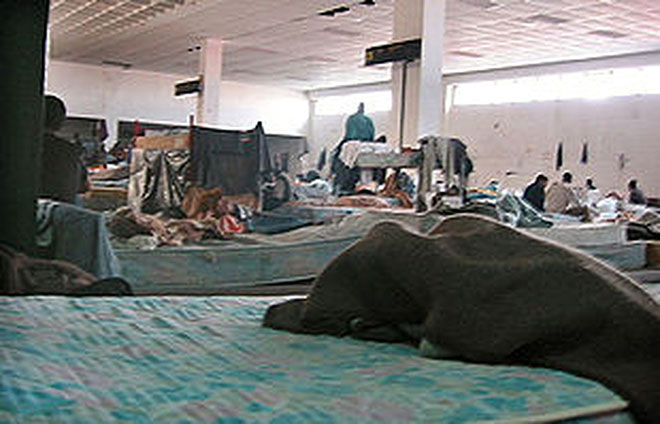
Photographer Javier Bauluz dedicated over 80 days capturing the plight of migrants in Gran Canaria, paying particular attention to conditions at the makeshift camp in Arguineguín. Here, nearly 2,700 migrants lived in makeshift shelters or even outdoors, crammed into just 3,000 square meters. The scene evoked memories of Fuerteventura’s airport terminal, which once housed up to 800 people in an area of just 900 square meters. “The only difference,” Bauluz argued, “is that in Arguineguín they are outdoors, and in the airport they were locked away without sunlight.”
Both sites witnessed alarming overcrowding and unhygienic conditions. The negligence of authorities and the absence of any regulatory framework meant that people were simply detained without safeguards. Reports about the suffering inside the Fuerteventura terminal were often restricted from public view, allowing abusive conditions to fester in the shadows.
Journalistic Resistance
When journalists attempted to shed light on these conditions, they faced significant obstacles. Outside the airport, Bauluz and fellow photographers protested their restricted access by gathering with blindfolds covering their eyes, holding cameras on the ground with a banner reading, “What are they hiding?” Persistence paid off for some; yet the old terminal remained largely off-limits to the press and NGOs, except for Cruz Roja Española, who battled to assist those trapped within.
Inside the Fuerteventura terminal, facilities were woefully inadequate. The design—measuring a mere 30 by 30 meters—included two rooms for detainees, separate offices for police, and a hygiene area with a limited number of showers and toilets. Existing in an enclosed environment with no outdoor access, detainees were left to languish in squalor.
Human Rights Abuses
Gerardo Mesa, who once served as the President of Cruz Roja in Fuerteventura, recalls the appalling conditions that were typical at the terminal. Overcrowding exacerbated the risk of disease, while the lack of adequate sanitation and light further demoralized the detainees. Individuals often resorted to using notes to communicate with family, clinging to these fragile threads of connection, particularly since mobile phones were absent.
The troubling conditions did not go unnoticed by human rights organizations. Reports filed with the United Nations and the European Union in response to the situation called attention to the ongoing violations. The 2002 report by Human Rights Watch titled The Other Side of the Canary Islands poignantly outlined that detainees faced “degrading treatment” during their confinement, often exceeding 40 days without any means of contacting the outside world.
Media Coverage and Public Response
As the media spotlight shined on the old airport, controversies erupted in Spain’s Congress regarding the treatment of immigrants. Denial of human rights violations characterized the government’s dismissive response, even as journalists captured testimonials about crumbling hygiene standards. One journalist found that at times, “one toilet served a hundred people,” a clear indicator of the scale of neglect.
On the front lines of humanitarian efforts, Médecins Sans Frontières (Doctors Without Borders) managed to obtain damning photographs showcasing the grotesque overcrowding, only for their access to be restricted afterward. The testimonies shared by both volunteers and those detained speak volumes about the human suffering experienced within those walls.
Lasting Impact and Ongoing Challenges
The old terminal functioned for four years, accommodating over 16,000 individuals from sub-Saharan Africa and Morocco. Many arrived with aspirations, yet the reality of their reception was laden with despair. It wasn’t until 2003 that a new facility, designed explicitly for Detention of Immigrants, was established in El Matorral, yet overcrowding and rights violations persisted.
The legacy of these incidents lingers, reminding us of the urgent need for humane and organized responses to immigration flows—an issue that continues to burden not only the Canary Islands but also the European Union as a whole. The stories of these individuals, their dreams, and their struggles remain etched in the collective memory, compelling us to reflect on the societal responsibilities that extend beyond borders.