A Historic Address: Pope Leo XIV’s Impactful Speech to the Spanish Parliament
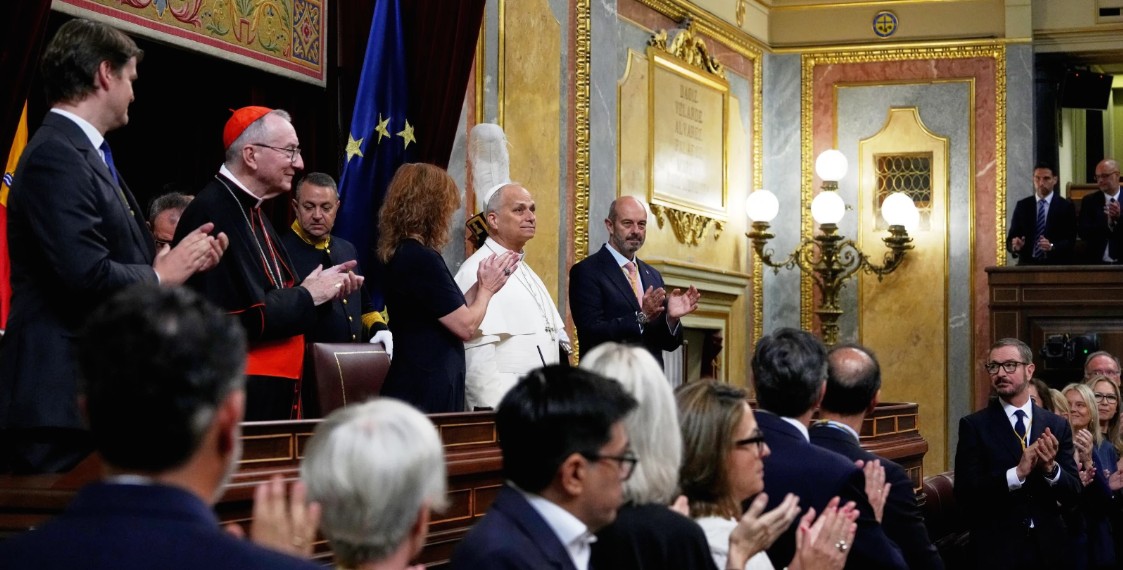
On June 9, 2026, a momentous event unfolded in Madrid, Spain, as Pope Leo XIV delivered a historic address to the Spanish Parliament, known as the Cortes Generales. This unprecedented occasion marked the first time a Pope had spoken before Spain’s national legislature, and it was met with an overwhelming response. Lawmakers rose to their feet, applauding for over seven minutes, accompanied by chants of “Viva il Papa!” (“Long live the Pope!”). This remarkable reception not only highlighted the Pope’s moral authority but also underscored the evolving relationship between the Catholic Church and modern Spain.
The Significance of the Standing Ovation
The seven-minute ovation was not merely a display of respect; it signified a deeper recognition of the Pope’s moral leadership in a nation that has seen a decline in religious observance over recent decades. Spain, once a bastion of Catholicism, has become increasingly secular, with many younger citizens identifying as non-religious. The applause from lawmakers across the political spectrum indicated a collective acknowledgment of the Pope’s appeal to universal moral principles, transcending partisan divides.
This moment resonated with Catholics worldwide, symbolizing the Church’s enduring role as a voice for conscience, justice, and human dignity in a fragmented world. It was a powerful reminder that, even in a secular society, the moral teachings of the Church continue to hold relevance.
A Call for Moral Renewal
Central to Pope Leo XIV’s address was a clarion call for a “moral renewal” in public life. He emphasized that the true measure of a nation lies in its capacity to protect and uplift its most vulnerable citizens. “The moral greatness of a nation is manifested, above all, in its capacity to accompany, protect and love those lives that are most fragile,” he stated. This assertion served as a poignant reminder that political leadership should prioritize the well-being of people over mere legislative or economic concerns.
Throughout his speech, the Pope underscored the inherent dignity of every human being, urging lawmakers to let this principle guide their decisions and policies. His message echoed the Church’s longstanding social teaching that a society’s worth is determined by how it treats its weakest members.
Advocating for Migrants’ Rights
One of the most pressing themes in the Pope’s address was the issue of migration. Building on the pastoral priorities of his predecessor, Pope Francis, Leo XIV called for a compassionate and balanced approach to migrants and refugees. He urged governments to create safe and legal pathways for migration while addressing the root causes that compel individuals to leave their homes, such as war, poverty, and climate change.
The Pope’s emphasis on the human aspect of migration was clear: migrants are not mere statistics or political issues but individuals deserving of dignity and respect. He reminded lawmakers of their responsibility to welcome those seeking protection and to foster opportunities for meaningful integration.
Promoting Peace and Upholding International Law
In a world increasingly fraught with conflict, Pope Leo XIV’s address also served as a timely appeal for peace and adherence to international law. He cautioned against the normalization of military confrontation as a solution to global disputes, advocating instead for dialogue and diplomacy. His call for “diplomatic courage” resonated deeply, especially in light of escalating tensions in various regions, including the Middle East.
The Pope’s insistence on peaceful conflict resolution reinforced the Vatican’s long-standing message that true peace can only be achieved through justice, dialogue, and mutual respect among nations.
Addressing the Ethical Challenges of Technology
Another crucial aspect of the Pope’s speech was his focus on emerging technologies, particularly artificial intelligence. He expressed grave concerns about the potential misuse of autonomous weapons systems and the ethical implications of allowing machines to make life-and-death decisions. Pope Leo XIV called for rigorous ethical oversight in technological advancements, emphasizing that moral responsibility must always rest with human beings.
His remarks highlighted the Church’s commitment to ensuring that technological progress aligns with ethical principles and respects human life, a concern that is increasingly relevant in today’s rapidly evolving landscape.
Drawing from Historical Wisdom
Pope Leo XIV also invoked Spain’s rich intellectual heritage by praising the sixteenth-century School of Salamanca, which laid the groundwork for early concepts of international law and human rights. He acknowledged that while these thinkers championed moral limits on power, neither society nor the Church has always lived up to these ideals. His candid acknowledgment of historical failures, including colonialism and slavery, reflected a commitment to truth, repentance, and reconciliation.
Warning Against Political Polarization
In a time of heightened political tensions, the Pope’s address included a caution against the dangers of political polarization. He emphasized that healthy disagreement is essential in democratic societies, but it must not devolve into hostility or personal attacks. His message resonated particularly in contemporary Spain, where political divisions have become increasingly pronounced.
Pope Leo XIV’s call for respect and civility in political discourse served as a reminder that the ultimate goal of politics should be the common good, rather than deepening societal divides.
A Moment of Joy for the Church
The Vatican has recognized the significance of the standing ovation, viewing it as an affirmation of the values articulated by Pope Leo XIV: compassion, justice, peace, and responsible leadership. For many Catholics, this event was a source of joy and hope, reinforcing the idea that the Church’s message continues to resonate even in secular contexts.
The ovation was not merely a tribute to Pope Leo XIV as an individual; it represented a broader appreciation for the enduring moral witness of the Church and the timeless truths of the Gospel.
A Powerful Sign of Hope
As the chants of “Viva il Papa!” echoed through the halls of the Spanish Parliament, Catholics around the world witnessed a remarkable moment in the life of the Church. The seven-minute applause became a visible sign that the voice of the Successor of St. Peter continues to inspire respect and hope in an age searching for moral direction.
In a Europe often portrayed as distanced from its Christian roots, Pope Leo XIV’s historic reception in Madrid served as a powerful reminder of the Church’s mission: to proclaim the dignity of every person, defend the vulnerable, and promote justice and the common good. This moment was more than a parliamentary gesture; it was an acknowledgment that the values at the heart of the Gospel continue to resonate with humanity’s deepest aspirations.