Uncovering the Ancient World: Archaeological Prospection at the Roman Site of Isla de Lobos
The charming Isla de Lobos, nestled just north of Fuerteventura in the Canary Islands, has gained recent attention for its remarkable archaeological significance. Newly discovered structures have prompted archaeologists to ponder the possibility that this ancient Roman site, referred to as Lobos 1, may extend beyond initial projections, captivating researchers and enthusiasts alike.
New Discoveries and Ongoing Surprises
Mercedes del Arco Aguilar, the co-director of the excavation project and curator at the Archaeological Museum of Tenerife, expressed her excitement about the latest findings during the eighth excavation campaign. Launched in 2012 following the site’s discovery, her team’s efforts have continually unearthed artifacts that challenge previously held notions about the site.
In a recent prospection conducted with ground-penetrating radar, the team has confirmed the presence of a newly identified floor structure, suggesting that the site may hold further undiscovered archaeological treasures. “The site continues to surprise us,” Aguilar remarked, indicating a thrilling chapter ahead for ongoing archaeological investigations.
Exploring Isla de Lobos: The Southernmost Roman Settlement
Dr. Isidoro Hernández Sánchez, director of the Archaeological Museum of Fuerteventura and co-director of the excavation, has reiterated the site’s historical importance. Estimated to be around 2000 years old, the artifacts, including goat bones and ceramics, suggest usage during the first century AD. During this period, it is believed that the Romans frequented Fuerteventura for around a century.
Interestingly, Isla de Lobos holds the distinction of being the southernmost Roman settlement in the world. While it shares this honor with two other sites in Lanzarote—El Bebedero and Buenavista—both of those are significantly younger, dating to about two centuries later.
A Purple Dye Workshop: Treasures from the Sea
Since its discovery, Lobos 1 has increasingly been recognized as a purple dye workshop, where a valuable hue derived from a marine mollusk known as the “cañaílla” (Muricidae) was produced. This dye, used in ancient times to color textiles, stood as a symbol of prestige and power. Given the mollusk’s abundance in the region during antiquity, the implications of such a workshop underline the economic activities that once thrived on this small island.
Ground Penetrating Radar Findings: A Glimpse into the Past
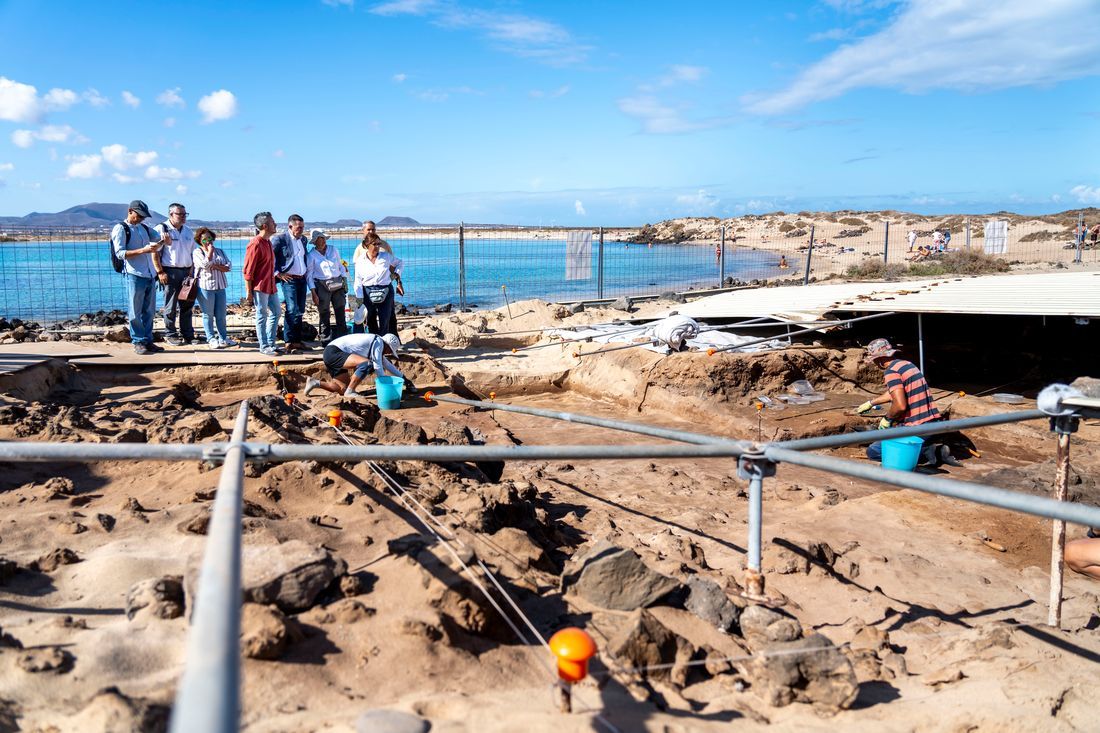
In 2023, a ground-penetrating radar survey conducted at the excavation site by Playa de La Calera identified previously unknown fertile areas, igniting hopes for new archaeological insights. The excavation has covered about 400 square meters; however, the recent focus has shifted to a 32-square-meter section in the northern region, where intriguing new structures have been uncovered.
In the southern area, an extensive 40-square-meter excavation yielded a tiled floor, occupying a square grid of two by two meters. While it appears to extend further into the site, further investigations are required to clarify its dimensions and functional purpose. This new finding adds an exciting layer of mystery and potential to the ongoing exploration of Isla de Lobos.
Prospects for Cultural Heritage in Fuerteventura
Local authorities have taken a keen interest in the excavation site, with a recent visit attended by key figures, including Rayco León, the cultural heritage adviser. León highlighted that the Lobos site forms a cornerstone of Canary Islands history, generating essential discussions and knowledge about the Roman presence in the islands.
The archaeological evidence uncovered at Lobos sparks a lively academic debate regarding the early civilization of the Canary Islands. Scholars remain divided on the very nature of the islands’ settlement, thus urging further research and exploration.
Future Aspirations: A Musealization Project
Looking ahead, plans are in motion to transform the Lobos archaeological site into a more accessible cultural heritage destination. The potential for musealization—creating a museum space—could conserve the site while providing visitors with an understanding of its historical significance.
Isidoro Hernández has noted that preparations for such a project may involve landscaping the area, replacing existing coverage, and establishing a “museum of the site” compliant with heritage laws, permitting the public to explore this ancient territory.
Collaboration Over the Years
The eight archaeological campaigns have resulted from a collaboration agreement between the Fuerteventura government and various institutions, including the University of La Laguna (ULL) and inter-island transport facilitators like Binter Canarias. Since the initial discovery in 2012, excavators have worked tirelessly to analyze ceramic materials stemming from the Roman era.
Each excavation, led by a multidisciplinary team of experts including Mercedes del Arco Aguilar and María del Carmen del Arco Aguilar, continues to yield fascinating archaeological records, enhancing our understanding of this unique chapter in the history of the Canary Islands.
With each dig, the Lobos site poignantly recalls tales from a time when Roman influence extended its reach across oceans, adapting to new environments and cultures, and inviting us to explore the rich tapestry of our shared human heritage.