The Hidden History of Valencia’s Central Market Square
Valencia’s Central Market Square, a vibrant hub filled with outdoor cafes and tourists snapping photos of its stunning modernist dome, holds a darker history. For centuries, this square was a key site in the slave trade, a fact documented in archival records dating back to the late 15th century. It served as one of the primary entry points for enslaved Africans into the Spanish city. Just a stone’s throw away, the now-demolished Posada del Camell was notorious for cramming over a hundred chained individuals, awaiting auction. Despite this significant history, there is a conspicuous absence of commemorative plaques or public acknowledgment.
Uncovering the Past
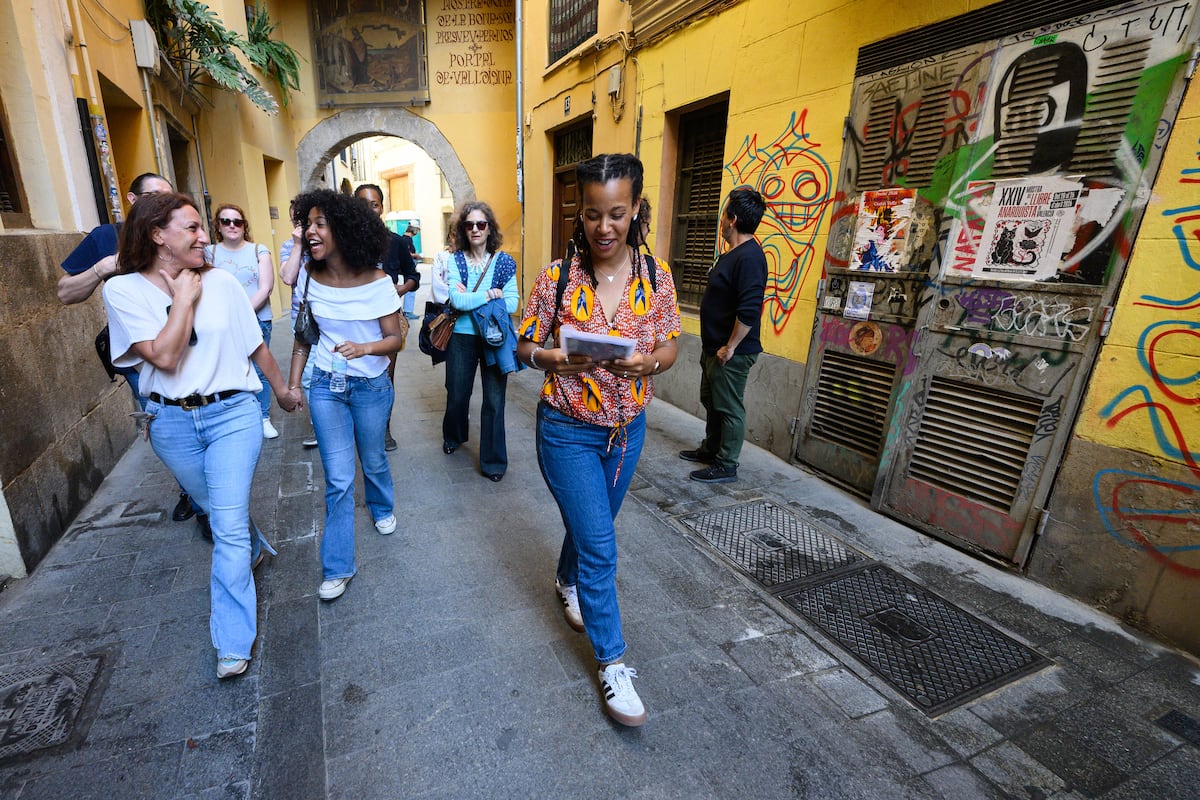
Deborah Ekoka, a cultural manager from Valencia, is at the forefront of efforts to bring this hidden history to light. She leads the initiative known as Cartographies of Black Memory, which aims to recover the historical presence of Black and Muslim communities in Valencia. Supported by the Trade Union Institute for Development Cooperation (ISCOD) and in collaboration with the Valencian Museum of Ethnology (l’ETNO), Ekoka’s project seeks to educate the public about the city’s multifaceted past.
Ekoka, whose father hails from Equatorial Guinea, reflects on her own experiences growing up in Valencia. She often faced the question, “Where are you from?” despite her Spanish heritage. Her father arrived in Spain when Equatorial Guinea was still a Spanish colony, yet the complexities of her identity were often overlooked due to the color of her skin.
A Broader Context
Valencia is not alone in its struggle to confront its historical narratives. Cities like Madrid, Barcelona, Seville, and Cádiz have begun to explore their own Black and slave-trading pasts through urban routes and cultural projects. These histories, well-documented in public and private archives, remain largely absent from the national narrative. Historian Ana Grau notes that Miguel de Cervantes once described Seville as a “chessboard,” highlighting its mixed Black and white population.
In Valencia, however, the erasure extends even to street names. The Carrer dels Negres, once a center of Afro-descendant life, has been renamed Calle de las Almas (Street of the Souls). Ekoka emphasizes that this lack of recognition in urban spaces reflects a broader trend of historical erasure.
The Historical Void
José Antonio Piqueras, a historian and head of the UNESCO Chair on Slavery and Afro-descendence at Jaume I University, argues that this void is not due to a lack of sources but rather a deliberate historical choice. He suggests that there is a reluctance to acknowledge the contributions of Black people to Spain’s history, which aligns with a desire to present a more homogeneous, white image of the nation.
This exclusion has tangible effects today. Esther Ejome, an Afro-descendant teacher from Valencia, shares her feelings of alienation despite being born in the city. She highlights how the narrative surrounding history has often marginalized the contributions of Black people, noting that in many historical texts, Africa is conspicuously absent.
Documented Presence
The documentation of Black presence in Spain is extensive. Piqueras points out that Valencia was a major slave-trading city during the late 15th and early 16th centuries. Between 1490 and 1520, more enslaved Africans arrived in Valencia than in all of the Americas during the same period. At one point, around 14% of the city’s population was enslaved, with a significant portion being Black individuals.
Interestingly, Piqueras notes that slavery was not always racialized. Before the 15th century, enslaved individuals came from various regions, including the Caucasus. The shift towards associating slavery predominantly with Black individuals occurred as the influx of Africans changed the dynamics of the slave trade.
Community and Resistance
The archives not only document the grim realities of the slave trade but also reveal the existence of support networks and community organizations. For instance, the Cofradía de los Negros de la Sagrada Virgen María de la Misericordia, founded in 1472 by freed Black men, served as a mutual aid network and a safe haven for those in need.
One poignant story from the archives involves Ursola, a Black enslaved woman who was brutally beaten by her owner. The brotherhood intervened, nursing her back to health, seeking justice against her attacker, and ultimately raising funds for her freedom. These narratives challenge the notion of enslaved people as passive victims, highlighting their agency and the existence of supportive structures.
Recognition in Arts and Society
There were also notable Black figures who made significant contributions to arts and society. The archives document individuals like Juan Latino, a humanist and professor, and Juan de Pareja, a painter who worked in Velázquez’s studio. Their stories serve as reminders of the rich, albeit often overlooked, contributions of Black individuals to Spanish culture.
The Call for Change
Activists like Yeison F. García López argue that the erasure of Black history perpetuates contemporary racism. He emphasizes the need for reparative measures that go beyond symbolic gestures, advocating for a comprehensive rethinking of the national narrative. This includes revising school curricula, urban signage, and ensuring access to archives and cultural production.
Transformative Initiatives
Initiatives like Ekoka’s Cartographies of Black Memory are not merely cultural exercises; they are vital interventions in the present. For participants in these tours, the Central Market transforms from a mere architectural landmark into a site of profound historical significance. As Ekoka aptly puts it, “Your perspective changes, and the city is no longer the same.”
Through these efforts, Valencia is beginning to reclaim its complex history, fostering a deeper understanding of its diverse past and the contributions of its Black and Afro-descendant communities.

