The Rising Tide of Protest in Santa Cruz de Tenerife
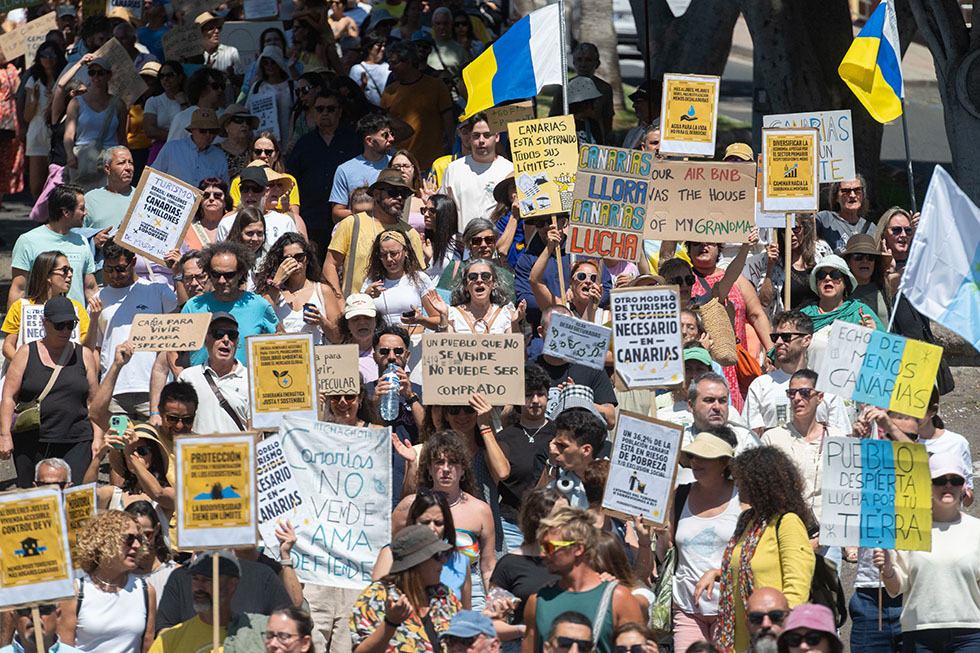
Recent protests in Santa Cruz de Tenerife have brought significant attention to the ongoing environmental and social issues facing the Canary Islands. With an impressive turnout of around 9,000 participants, according to police estimates, this gathering has emerged as one of the largest demonstrations in the archipelago’s history, culminating in a powerful display of public sentiment.
Voices of Concern and Advocacy
The protesters carried a variety of banners, notably featuring the iconic face of César Manrique, a renowned local artist and architect known for his commitment to environmental conservation. Alongside these, images of pollution plagued the beaches—a poignant reminder of the environmental neglect that many believe is threatening their natural beauty. Slogans such as “No to sewage discharges,” “The biodiversity of the Canaries has its limits,” and “Ecotax now!” rang out through the capital, invigorated by the sounds of drums and traditional chácaras (a type of percussion instrument).
Among the issues highlighted during the march was a growing frustration with the local government’s handling of development projects. The protestors chanted, “Clavijo, listen, the people are in the fight,” expressing their desire for meaningful dialogue and action regarding ongoing urbanization projects that they believe jeopardize sensitive areas like El Médano and the Puertito de Adeje.
Concrete Demands from Local Leaders
Rubén Pérez, spokesperson for the environmental group Salvar La Tejita, articulated urgent demands for the suspension of large-scale infrastructure developments. He specifically called for the local government to purchase and restore land designated for a hotel near La Tejita beach, arguing that such measures would protect both the cherished coastal environment and the welfare of the residents.
In Las Palmas de Gran Canaria, a parallel protest launched from the Alfredo Kraus Auditorium emphasized issues such as housing and the need to halt incompatible projects. Roughly 5,500 demonstrators marched along the iconic Las Canteras promenade, firmly asserting that the right to a dignified life in the Canaries should take precedence over tourist interests.
A Persistent Echo of Dissent
The protests represent a culmination of frustrations that have been brewing over the past year. Noelia Sánchez, spokesperson for Ben Magec-Ecologistas en Acción, pointed out that this was the third such mobilization and criticized the Canary government for ignoring previous calls for action on the pressing issue of over-tourism and its impact on the housing market.
Her sentiments echoed those of Jaime Coello from the Fundación Canaria Telesforo Bravo, who noted the stark disconnect between governmental promises of dialogue and the community’s long-standing proposals concerning moratoria on tourism and initiatives for an ecotax.
Scrutiny of Economic Policies
Concerns have also been raised in Valverde, El Hierro, where a gathering of around a hundred individuals decried the current unsustainable economic model reliant on unregulated mass tourism. Activists argue that existing regulations only serve to deepen the social crises linked to speculation and economic inequality. They criticized recent legislative initiatives, like modifications to the Land Law, which many believe exacerbate rather than alleviate existing problems.
Likewise, in La Gomera, about 50 people rallied in front of their town hall, combining protests against overdevelopment with cultural expressions such as the local batucada—a traditional percussion ensemble.
A Shift Towards More Direct Action
In Lanzarote, the urgency of the situation was palpable as thousands marched from the Casa de la Cultura to the Cabildo. Participants drew attention to water scarcity, lack of housing, and the ongoing impacts of mass tourism on local communities. Organizers signaled the start of a new phase of activism, one that promises to be more disruptive, as they plan to challenge public events and occupy tourist hotspots.
Addressing the Housing Crisis in La Palma
On La Palma, a separate demonstration saw around 600 people marching through the streets, demanding urgent housing solutions exacerbated by the 2021 volcanic eruption. The community reiterated the importance of preserving their natural environment from the threats posed by ongoing construction and tourism-related pressures.
As speakers called for a halt to environmental degradation caused by aggregate extraction near affected areas, they pledged to guard against the spread of mass tourism that has troubled neighboring islands.
A Wider Movement for Environmental and Social Justice
The demonstrated will for change across the Canary Islands reflects a growing consciousness about the implications of tourism, development, and ecological integrity. These mobilizations involve concerned citizens from diverse backgrounds, all uniting to champion both environmental sustainability and social equity, striving to carve out a more balanced future for their beloved islands.