Recent Archaeological Campaign on Lobos Island
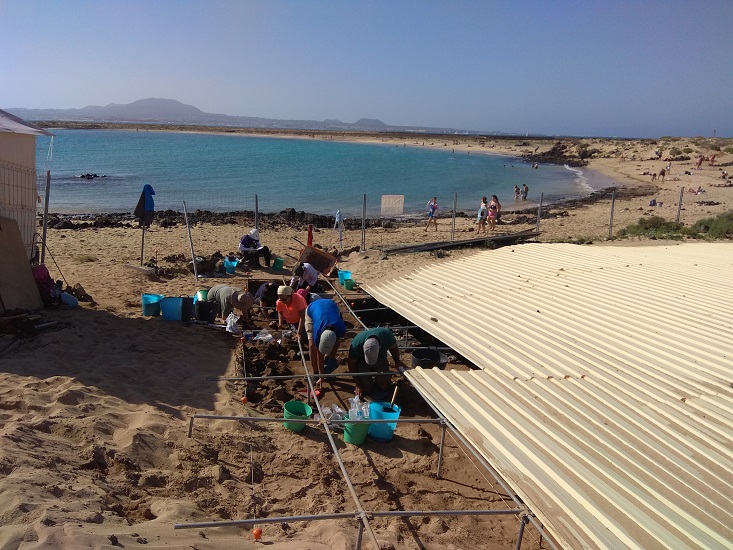
Just a few days ago, an exciting new archaeological excavation campaign concluded at the Roman site of Lobos Island, a part of the research project “Towards the Definition of Purpura Islands: From the Purple Workshop of Lobos 1.” This initiative, nestled within the broader efforts to understand the historical significance of this locale, is economically supported by a collaboration agreement between the Cabildo of Fuerteventura and the Autonomous Organism of Museums and Centers. It is co-directed by researchers from both institutions and the University of La Laguna, bringing together a diverse team of interdisciplinary experts.
Excavating Lobos 1
The archaeological work conducted during the November-December 2022 campaign primarily focused on continuing the excavation of Lobos 1, which is recognized as a Roman purple dye workshop dating back to the Late Republican and Early Imperial periods. The main objective was to define the extent and occupation of the southern area of this significant site. The focus on Lobos 1 is crucial, as it sheds light on ancient production techniques and daily life.
The Role of Purple Dye in Roman Society
Lobos 1 served as a technological hub dedicated to the production of purple dye, a highly coveted hue in Roman society that signified power and prestige. This luxurious color was primarily derived from certain marine mollusks belonging to the Muricidae family. In the excavations, researchers identified a particular focus on Stramonita haemastoma and, to a lesser extent, Hexaplex duplex.
The remnants found—primarily shells—are housed in shell middens characterized by over 98% representation of these mollusks. The shells exhibit anthropogenic processing marks, demonstrating techniques essential for extracting the dye’s precursor material from the mollusk’s hypobranchial gland. Once collected, this substance underwent a meticulous extraction process, involving prolonged immersion in a liquid mixture containing alkaline substances, which was then slowly cooked in lead cauldrons.
Tools and Daily Activities
The site also yielded various tools indicative of the purple dye-making process. Among these are basalt anvils and pounders, fragments of iron sheets potentially used as knives, combustion structures, and remnants of lead cauldrons. Beyond dye production, other areas within Lobos reveal the varied activities undertaken by these ancient workers, including the exploitation of marine resources. Evidence of fishing, shellfish gathering, and the processing of other biotic resources was plentiful, with specialized tools such as copper hooks, stone and lead net weights, and iron harpoon tips discovered alongside abundant remains of caprines and pigs.
Insights into Domestic Life
This year’s campaign unearthed what appears to be a significant refuse area, rich in fragments from daily life. Researchers cataloged plentiful caprine remains, evidencing butchering techniques; fish and shellfish residues; and a range of Roman-type ceramic artifacts, from amphorae to cooking and tableware, as well as lamps, metallic implements like hooks and nails, and other everyday items. Notably, they also identified a shell midden, categorized as the seventh of its kind at the site, which revealed sediment layers tinged with vivid purple hues and calcareous nodules—clear indicators of the residue left from dye processing and cleaning activities.
Discoveries Awaiting Further Exploration
Although the exact dimensions of this new refuse area remain undetermined, future excavations promise to yield more insights. Researchers are eager to explore the structural remains of a probable seven-meter-long wall adjacent to these refuse dumps. The anticipation surrounding the upcoming fieldwork is palpable, as the team looks forward to more discoveries that might extend southward, enhancing our understanding of this ancient settlement and its broader context.
A Collaborative Endeavor
The ongoing research at Lobos Island thrives on the collaborative spirit fostered by the partnership between local authorities, universities, and various archaeological entities. The project harnesses a blend of historical analysis, archaeological methods, and modern technology, demonstrating the richness of Fuerteventura’s past and its relevance to the understanding of Roman economic and social practices.
A Glimpse into the Future
With such exciting findings and the promise of deeper investigations to come, the Lopos Island archaeological team is preparing for the next campaign with anticipation. Each discovery adds another layer to the complex narrative of ancient life, providing invaluable insights into the craftsmanship, commerce, and daily activities of a community long gone but not forgotten.