The European energy landscape is undergoing a significant transformation, particularly in the realm of renewable energy. A recent report highlights the potential for hybridisation of hydropower facilities across several EU countries, including Austria, Bulgaria, France, Italy, Portugal, Romania, and Spain. Together, these nations boast a hydropower fleet of 93GW out of the EU’s total 131GW. This hybridisation could enable the integration of new renewable generation behind existing grid connection points, presenting a promising avenue for enhancing energy capacity without the need for extensive grid upgrades.
According to Ember, the additional 25GW of capacity that could be unlocked through this hybridisation represents 18% of the approximately 138GW of wind and solar power expected to be deployed in these seven countries between 2026 and 2030. This innovative approach allows for the connection of new renewable energy sources without necessitating additional grid capacity or interventions, thereby streamlining the process of expanding renewable energy infrastructure.
In an insightful conversation with Elisabeth Cremona, the energy infrastructures lead at Ember and the report’s lead author, she emphasized the urgency of addressing the backlog of renewable projects. “With almost 700 GW of wind and solar blocked in the queue across 10 EU countries alone, solutions that allow renewables to bypass grid connection queues are crucial,” she stated. Hybrid projects not only have the potential to ‘jump the queue’ but can also come online more quickly since they do not have to wait for grid reinforcements. This is particularly vital for countries like Austria, Bulgaria, Portugal, and Romania, where grid availability is severely limited.
Grid Bottlenecks Drive Need for Hybridisation
The report arrives at a critical juncture as Europe grapples with increasing pressure on its electricity networks due to rapid renewable deployment and electrification. Ember estimates a staggering grid capacity gap of over 120GW between the available network capacity and the anticipated growth of renewables by 2030. This gap is already causing delays in new renewable connections and influencing investment decisions across the continent.
Cremona pointed out that the long-term goal is to construct a grid that efficiently supports Europe’s strategic energy objectives. “This necessitates maximizing the use of existing infrastructure while also planning for future expansions,” she explained. Hybridisation emerges as a viable solution to this challenge, allowing for immediate deployment of renewable energy in grid-constrained markets by making the most of existing assets.
Hybrid projects, which combine multiple generation technologies behind a single grid connection point, enable more efficient use of existing infrastructure while adhering to grid injection limits. This innovative approach could significantly alleviate the pressure on the grid while facilitating the transition to renewable energy.
Existing Grid Connections Could Nearly Double Utilisation
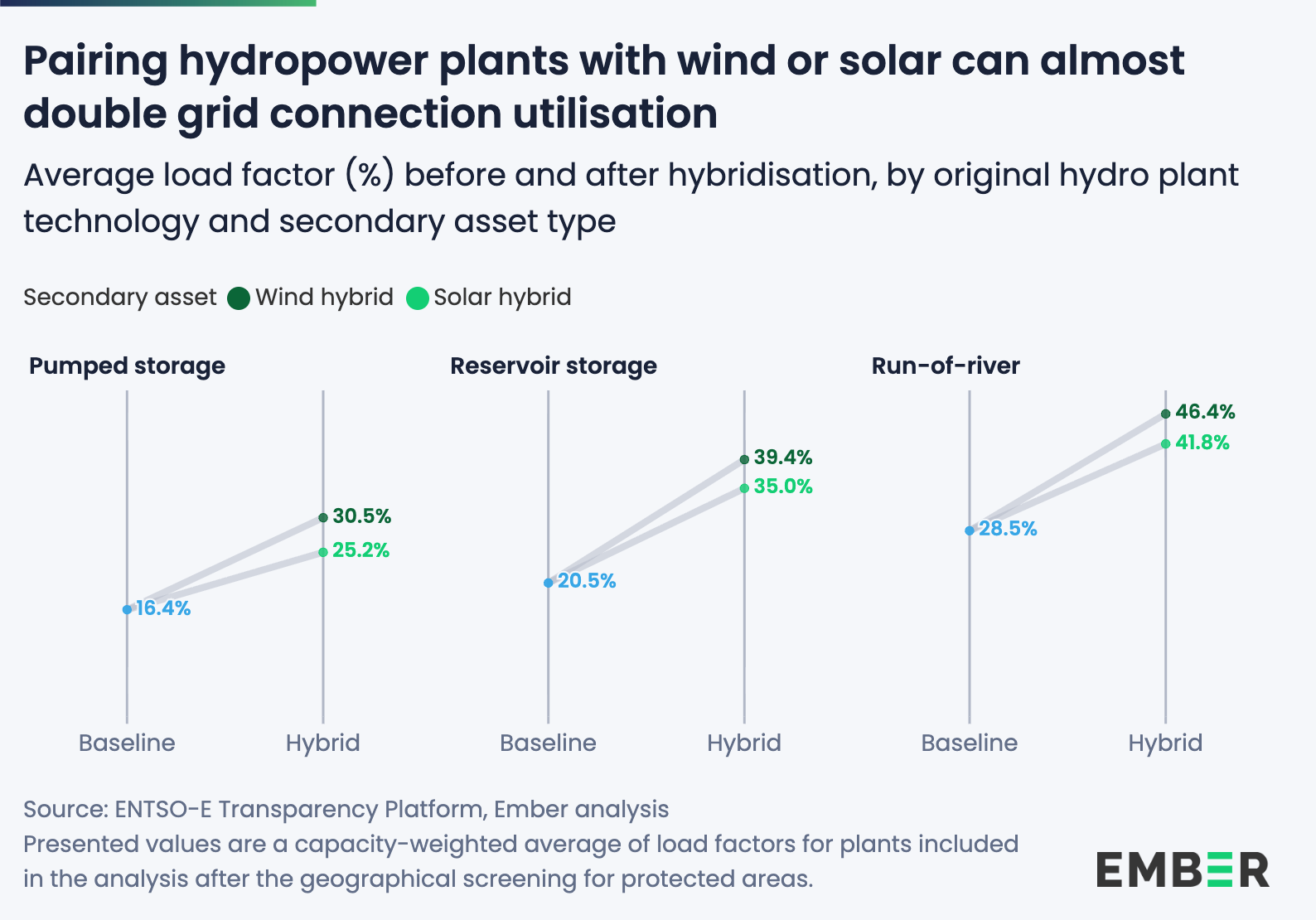
The analysis reveals that hydropower facilities are particularly well-suited for hybridisation, as they often operate well below their maximum grid connection capacity. Currently, reservoir storage and pumped storage plants eligible for hybridisation operate at an average capacity factor of just 19%. By integrating solar energy, this average could rise to 36%, while wind could elevate it to 31%. In some instances, the addition of wind and solar could more than triple the utilisation of existing grid infrastructure.
Run-of-river hydropower plants, which typically have a higher average capacity factor of 29%, could see their utilisation increase to 47% with solar and 42% with wind. “Looking solely at hybridising hydropower plants illustrates the large potential for renewable deployment behind existing grid connections,” Cremona emphasized, noting that this could cover 18% of the renewables pipeline across the seven countries from 2026 to 2030.
Moreover, hydropower generation tends to peak during morning and evening demand periods, creating a complementary generation profile with solar, which generates electricity during the midday hours. This synergy enhances the overall efficiency of the energy system.
Hybridisation Potential Varies Across Countries
The report also highlights that the potential for hybridisation varies significantly across the seven countries assessed. For instance, Austria could integrate up to 77% of its planned renewable deployment through hydropower hybridisation, while Bulgaria could only manage 7%. These disparities reflect the availability of suitable hydropower sites for additional renewable generation.
Interestingly, the report excludes hydropower plants located in environmentally protected areas from its assessment. Approximately 28% of large hydropower capacity across the seven countries is considered eligible for hybridisation, with Austria and Italy leading the way at 41% and 28%, respectively, while Bulgaria lags behind at just 6%.
Cremona anticipates that the most significant near-term solar deployment through hybridisation will occur in Portugal and Spain, where the regulatory frameworks are already conducive to such projects. “Hybrid projects can proceed even where regulation is absent, but the process is likely to be more complicated and lengthier,” she noted.
Regulatory Support Remains Limited
Despite the technical potential for hybridisation, the report indicates that regulatory frameworks across most of the EU remain underdeveloped. Among the seven countries examined, only Portugal and Spain have established dedicated regulations to support hybrid projects. These nations have streamlined permitting processes and reduced administrative barriers, making it easier to accelerate hybridisation.
For example, Spain allows hybrid projects to bypass the traditional “first-come, first-served” grid connection process and reduces financial guarantees for hybrid connection requests by 50%. Both Spain and Portugal also waive environmental screening for hybridisation projects that remain within the existing footprint of generation facilities.
In contrast, project developers in countries without specific regulations face challenges related to grid connection rights, capacity allocation, and permitting rules designed for single-technology projects. “Establishing national legislation that enables hybridisation is a quick and no-regrets way to get more renewables online faster while reducing grid investment needs,” Cremona argued, pointing to Portugal and Spain as models for such policies.
Even in the absence of dedicated legislation, hybrid projects are making headway. The report notes operational projects in France and highlights Bulgaria’s state-owned utility NEK, which is converting hydropower assets into battery-coupled hybrid facilities while exploring floating solar projects at existing dams.
Cremona concluded by emphasizing that hybridisation is not just a unique case for hydropower but represents a broader opportunity across various energy sectors. “The same logic applies wherever there’s spare capacity behind a connection point,” she stated. Hybridisation can be integrated into new projects or added to existing facilities, particularly as Europe’s wind fleet undergoes repowering in the coming years.
The report advocates for national governments to establish dedicated legislation for hybrid projects and streamline permitting and grid connection procedures to expedite deployment. It also calls for EU-level guidance on hybrid projects, arguing that harmonised rules would provide greater regulatory certainty and foster investment across multiple Member States.