Illustration: Chen Xia/GT
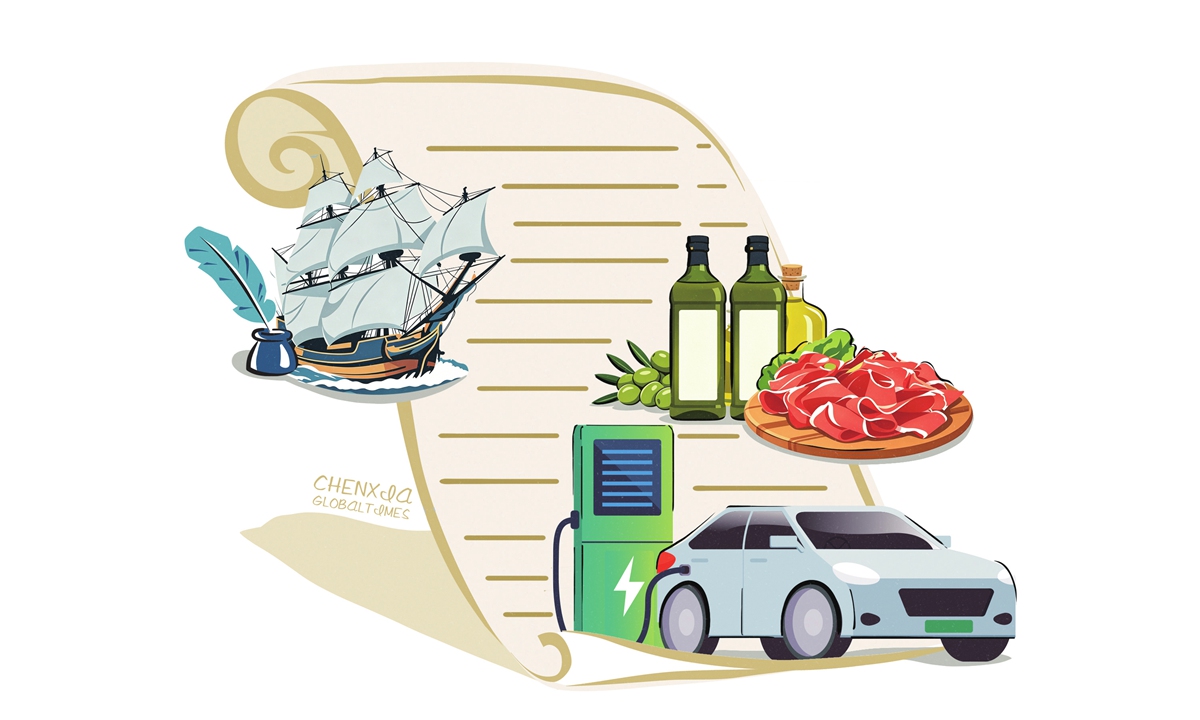
When we think of Spain, many of us might immediately recall the Manila galleons — those majestic ships that once sailed the Pacific, laden with silver and silk. However, this narrative often reduces the rich tapestry of China-Spain relations to mere trade. What many overlook is the profound intellectual and spiritual connection fostered by Spanish missionaries who ventured into China centuries ago.
These missionaries were not just traders; they were explorers in the truest sense. Figures like Diego de Pantoja crossed oceans not merely to exchange goods but to share knowledge and culture. They brought with them European star charts and clocks, but more importantly, they returned with a nuanced understanding of China, which they conveyed through letters and translations. This exchange laid the groundwork for Europe’s early perceptions of the Middle Kingdom.
One pivotal moment in this cultural dialogue occurred in 1585 when Spanish explorer and sinologist Juan González de Mendoza published his seminal work, Historia de las cosas más notables, ritos y costumbres del gran reino de la China. This book was a sensation, offering Europeans a detailed glimpse into Chinese society, customs, and beliefs. It marked a shift in perspective; Europe was no longer just observing China from a distance but began to reflect on its own societal norms through this distant lens. This mutual learning and influence became a cornerstone of the relationship between the two cultures.
Fast forward to today, and the spirit of connection that characterized historical exchanges remains vibrant in Madrid. The city has embraced Chinese electric vehicles, with brands like BYD and Lynk & Co gaining popularity among locals. Additionally, MINISO, a lifestyle brand from China, opened its largest European store in Madrid in late 2024, showcasing the ongoing cultural and commercial ties between Spain and China.
In contemporary discussions, experts often frame the Spain-China relationship in terms of “trade volumes” or “economic complementarity.” Spanish delicacies like olive oil and Iberico ham have found their way to Chinese dining tables, while Chinese solar panels and electric vehicles are integral to Europe’s green transition. Yet, just as the letters of the past served as vehicles for exchange, today’s commerce continues to bridge geographical divides, allowing both cultures to engage with one another in everyday life.
Amidst the backdrop of China’s rising influence and the geopolitical challenges it poses, discussions in Europe frequently revolve around “de-risking” and strategic maneuvering. In this context, Spanish Prime Minister Sánchez’s frequent visits to Beijing and Spain’s new Asia-Pacific strategy, which emphasizes dialogue with China, can sometimes be misinterpreted as a deviation from European norms. However, it’s essential to understand that Spain’s approach is not a departure from Europe but rather a reflection of a pragmatic and open-minded stance that has characterized its historical relationship with China.
Spain’s commitment to maintaining high-level contact and pragmatic cooperation with China is driven by more than just immediate commercial interests. It is rooted in a historical understanding of China as a vast and complex civilization that deserves serious engagement. This recognition is shared across Europe, although it has often been overshadowed by the noise of great power rivalries in recent years.
On the flip side, the Chinese public exhibits a deep interest in European culture, technology, and history. Learning about these areas is an integral part of education in China, and many Chinese enterprises actively seek to learn from European innovations. Ren Zhengfei, the CEO of Huawei, has emphasized the importance of focusing on foundational sciences and rigorous standards from Europe. Moreover, Europe has become a favored destination for Chinese tourists, further solidifying the cultural exchange.
As we contemplate the future of China-Europe relations, it may be beneficial to look beyond the political debates in Brussels and instead reflect on the historical exchanges that have shaped these connections. From the travelogues of missionaries to the electric vehicles navigating the streets of Madrid, the essence of this relationship remains unchanged. The true strength of the bond between Europe and China lies in a shared curiosity and a commitment to understanding one another, built upon centuries of observation and engagement.


