The Legacy of Livestock: Lara Rodríguez and Her Family’s Dairy Farm in Lajares
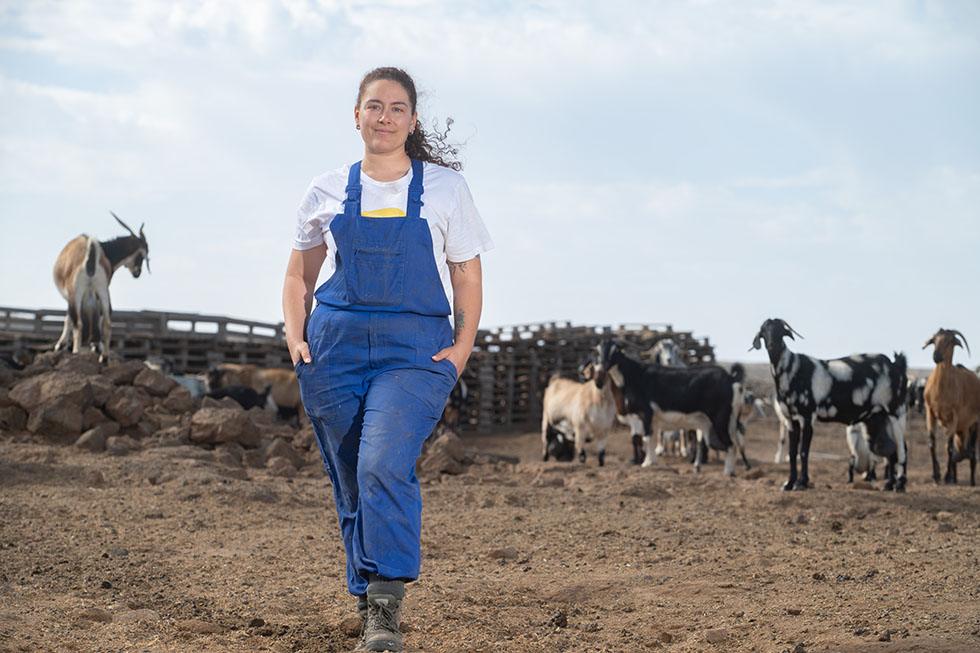
In the picturesque village of Lajares, nestled in the heart of Fuerteventura, Lara Rodríguez represents the fourth generation of a proud farming lineage. At just 27 years old, she dedicates her life to cattle farming alongside her father, Esteban Rodríguez, overseeing a herd of over 1,300 Majorera goats. This familial legacy, infused with passion and hard work, has been a pivotal part of Lara’s life since her earliest memories.
Growing up surrounded by goats, her formative years were spent alongside her grandmother and father. Esteban, recognizing the need for diversification in the family business, expanded their operations to include a transport sector. It’s no surprise, given these roots, that Lara chose to study advanced courses in livestock management and mechanics. She expresses her commitment simply: “Why work for someone else when I can work for my father? Ultimately, it’s for me as well.” Her dedication to farming is paralleled by the acknowledgment that the livestock sector demands extensive labor and countless hours.
The Daily Routine of a Dairy Farmer
The Rodríguez family farm focuses primarily on milk production, supplying to major cheese factories. On a good day, their expansive farm can yield up to 30,000 liters of milk, thanks to the support of additional employees. The day often begins before sunrise, with shifts tailored to the seasonal needs of the goats. During the recría season, starting in November, the demands increase significantly, requiring the family to be particularly vigilant.
Typically, a workday lasts around eight hours, unless it falls within the busy periods known as the “high season,” marking the critical months of November and February. Lara starts her mornings tending to the pregnant goats, which produce less milk and are milked every two days, followed by the non-pregnant ones. Among the chores that follow are cleaning the milking machines and the corrals, paired with feeding the animals to streamline the workflow.
Days off are a rare luxury in this line of work. Despite the demanding nature of their roles, Lara and her father manage to alternate time off to relish brief vacations. “If it’s not kidding season, we can take turns for short escapes, although it’s bittersweet that we can’t go together,” she observes.
The Challenges of Kidding Season
As November rolls in, the farm enters its busiest phase, coinciding with the birth of new kids (baifos). During this season, Lara remarks, “You have to be on alert nearly around the clock.” Besides routine tasks of milking, feeding, and cleaning, caring for the newborns adds a layer of complexity to their workload. Despite the toil, Lara finds satisfaction in nurturing the young goats and witnesses their growth.
Although caring for the kids requires immense effort, Lara acknowledges, “It’s fulfilling to see them thrive.” The farm operates extensively, allowing the goats to roam freely to ensure their health. The goats often wander outside the farm’s boundaries, enjoying their freedom while still returning home by day’s end, a habit they’ve cultivated over time.
A Shift to Milk Production
Historically, when the family farm was smaller, Esteban explored cheese production, a family tradition initiated by Lara’s grandmother. However, he soon realized that focusing solely on dairy production proved to be more lucrative. The evolution of the business, along with market demands, led to a shift from selling goats to concentrating on milk production, which ultimately became the farm’s main focus.
Tackling Modern Challenges
Nonetheless, livestock farming in Fuerteventura comes with its own set of challenges. Rising feed costs, water scarcity, and energy limitations consistently present hurdles. Despite fluctuations in feed costs, Lara points out that larger herds offer more profitability, whereas sustaining a smaller herd proves challenging in today’s market.
To combat water shortages, particularly during the summer months, the farm operates a water storage tank with a capacity of 30,000 liters, requiring frequent refills. Currently, the property lacks electrical supply; earlier operations relied on a motor, but advancements in solar technology have emerged. However, the growing herd and demanding tasks, especially in winter with shorter days, necessitate reliance on a diesel generator for additional energy.
The Rise of Young Farmers
Despite these challenges, Lara notes a gradual increase in young farmers entering the sector, drawn by enthusiasm for revitalizing the agricultural landscape of Majorera. However, with stagnant salaries, many are pressured by the rising cost of living. Lara emphasizes the resolve of newcomers who often begin from scratch, adding depth to the appeal of agriculture among the island’s youth.
In a landscape where women are underrepresented, Lara stands alongside a small group of young female farmers. She cites peers from different farms, like the daughters of Felipa Valdivia, who are breaking barriers in dairy and cheese production. “There’s another young woman in Tiscamanita working with family. Yet, we are few in numbers,” remarks Lara.
Efforts to Promote Agriculture
A strong advocate for local events supporting agriculture, Lara participates in the annual Agricultural and Livestock Fair, Feaga. This marks her third year in the milking competition, which began as an obligation but transformed into a passion for supporting the local farming community. “With fewer participants over the years, our involvement matters in keeping the event alive,” she explains.
Recognized as one of the key attractions at Feaga are the milking contests and auctions of male goats. While Lara hasn’t yet claimed a prize, she remains inspired by her father’s previous accolades. In the latest event, participants showcased impressive skills, with Esteban securing third place in the manual milking competition.
Lara’s journey as a young farmer encapsulates resilience in the face of modern-day challenges, maintaining the family’s agricultural legacy while navigating the complexities of the livestock industry in Fuerteventura. With determination and spirit, she embodies a commitment to her craft that honors her heritage while looking toward the future.