Fuerteventura Times – Business & Startups
Revitalizing Tourism: Fuerteventura’s Digital Transformation Sparks Economic Growth
In an era where digital engagement is reshaping industries, Fuerteventura is embracing a new wave of technological advancements to attract visitors and enhance the island’s economic landscape. The digitalization of its tourism sector not only aims to enhance traveler experiences but also seeks to maximize revenue streams for local businesses.
The island’s government has recognized the critical need for innovation. By investing in platforms that promote online booking and local attractions, they are making it easier for tourists to access Fuerteventura’s rich offerings. This digital push is not just about convenience; it positions Fuerteventura as a competitive player in the global tourism market, boosting the local economy and creating job opportunities. Entrepreneurs are encouraged to leverage these advancements, leading to a surge in startup initiatives tailored to the diverse needs of visitors.
As Fuerteventura adapts to the changing demands of tourists, the emphasis on sustainability and responsible travel practices is also taking center stage. By promoting eco-friendly tourism and local cultural experiences through these digital platforms, the island is not only appealing to a more conscientious traveler but is also ensuring the preservation of its unique environment and heritage. The collaboration between the government and local businesses signals a promising future, where innovation and sustainability go hand in hand to redefine the tourism landscape of the island.
Source: Gobierno de Canarias.
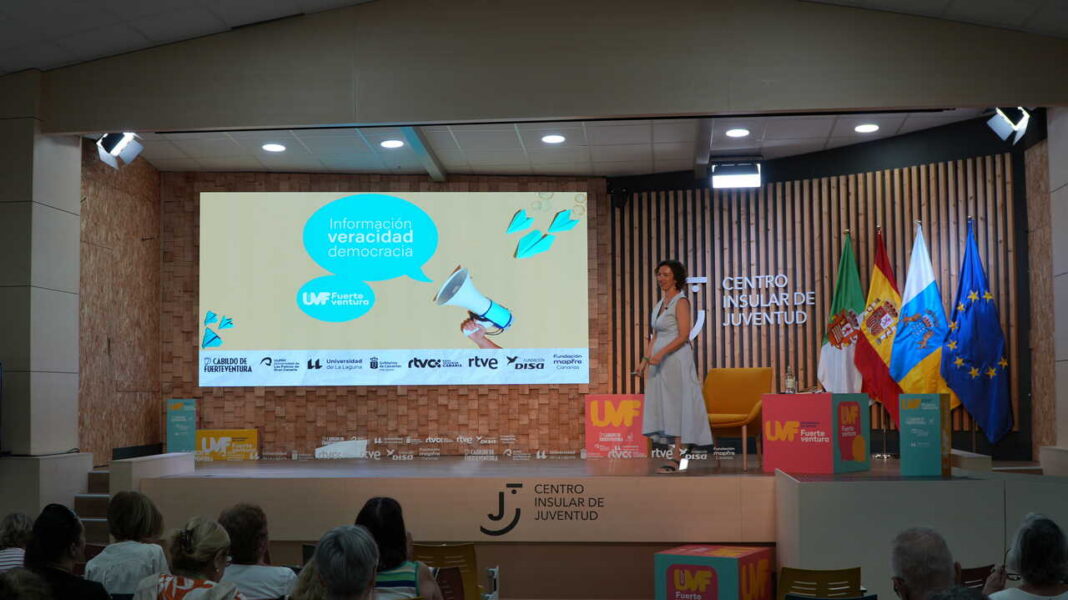
This Friday, the IV Summer University of Fuerteventura (UVF) put the final touch on an edition that, for five days, has brought together on the Island some of the main national specialists in journalism, communication, philosophy and technology to analyze one of the great challenges of our time: misinformation and its effects on democratic society. The closing day was dedicated to the tools necessary to confront this phenomenon, from journalistic verification and media literacy to philosophical reflection on the concept of truth. A journey that allowed the program to close with a practical and, at the same time, deeply humanistic look at the role that information and critical thinking play in the construction of free and responsible citizenship. The first intervention was given by Jorge Ocaña, journalist from EFE Verifica, with the conference “You are not immune: why we are all vulnerable to misinformation.” Starting from the premise that no person is completely protected from information manipulation, Ocaña explained some of the psychological and communicative mechanisms that favor the spread of hoaxes and recalled that misinformation often takes advantage of our own biases, emotions and information consumption habits. Next, Estefanía de Antonio, head of Verification, Data Journalism and Visual Narratives at RTVE, presented the conference “VerificaRTVE: anatomy of a hoax”. During his speech he showed how specialized verification units work to detect false content, reconstruct the origin of misinformation and offer citizens verified information. Likewise, he highlighted the importance of data journalism and new digital tools to combat the spread of fake news. Philosophical reflection came from the hand of Diego Garrocho with the conference “Does truth exist?” The professor of Ethics and Political Philosophy invited the public to dwell on an essential question in an era marked by an overabundance of information: the very meaning of truth and its importance for democratic coexistence. His intervention raised the need to vindicate critical thinking, rational debate and the shared search for knowledge as essential elements to confront the complexity of the contemporary world. The last presentation of the edition was led by Nereida Carrillo, president of Learn to Check and professor at the Autonomous University of Barcelona, who presented “Media education: proposals to counteract misinformation and improve democracies.” The researcher defended media literacy as an essential tool for citizens to identify misleading content, understand the functioning of digital ecosystems and exercise a more conscious and responsible consumption of information. This last day concludes the IV Summer University of Fuerteventura, an edition that has brought together journalists, researchers, philosophers, communicators, political strategists and verification specialists for five days to reflect on the challenges that disinformation poses to current democracies. The initiative has once again registered an excellent reception from citizens, consolidating itself as a reference space for debate, dissemination and critical thinking in the Canary Islands. Throughout this edition, the Summer University has addressed issues such as trust in the media, the impact of algorithms on democracy, artificial intelligence, verification strategies, climate disinformation, political communication and media education, offering citizens a broad and multidisciplinary vision of one of the phenomena that most affects contemporary society.
Originally reported by www.lavozdefuerteventura.com, rewritten by the Fuerteventura Times AI Editorial Desk.


