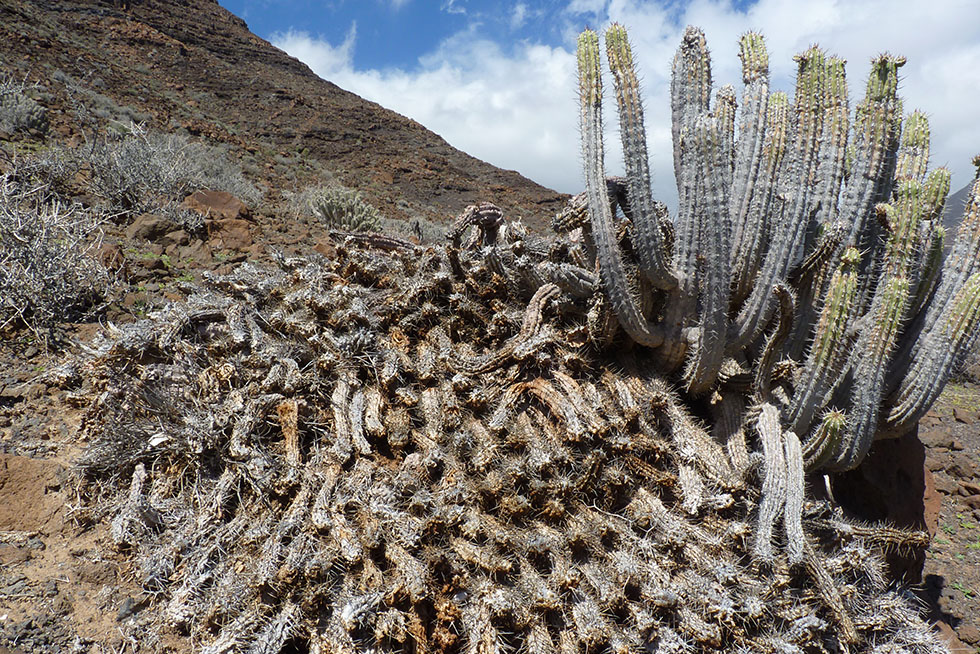
The Forgotten Jewel of Fuerteventura: The Jandía Cardón
At first glance, you might mistake it for a cactus, but the Jandía Cardón is in fact a member of the Euphorbia family. This extensive botanical group boasts over 2,000 species across the globe, making it one of the most diverse families of flowering plants. Among the eight species of Euphorbia found in the Canary Islands, only two are spiny: the towering Canarian Cardón (Euphorbia canariensis) and the diminutive Jandía Cardón (Euphorbia handiensis). The latter uniquely thrives solely on the island of Fuerteventura, specifically in the harshest, arid regions of Jandía, where heavy winds and searing temperatures often surpass 40 degrees Celsius.
A Symbol of Endurance
Small yet extraordinary, the Jandía Cardón is a spiny marvel nicknamed “cardón peludo” by the local residents. Declared a symbolic plant of Fuerteventura by the Canary Islands Government in 1991, it serves as a botanical treasure of the Jandía Natural Park. However, despite its prestigious title and a myriad of protective measures, the plant faces a disheartening decline. For over three decades, its once-vibrant populations have dwindled due to a myriad of threats, including uncontrollable pests, severe drought conditions, climate change, and the relentless trampling caused by free-roaming livestock in this otherwise protected area.
Signs of Decline
Recent scientific studies reveal dire warnings regarding the Jandía Cardón’s population. Research by botanist Stephan Scholz—who has dedicated nearly four decades to observing this plant—shows grave symptoms of weakening among these already scarce individuals. There’s a noticeable increase in dead specimens, and natural regeneration has nearly halted. In a recent article published in Euphorbia World, a scholarly journal by the International Euphorbia Society, Scholz poignantly warns, “Time is running out.”
Pathological Problems
The Jandía Cardón endures a dual assault on its health. On one side are the phytopathological issues—diseases caused by fungi, bacteria, and insects. On the other, there’s the persistent threat posed by livestock, primarily goats, which damage and disrupt its habitat.
Scholz categorizes the symptoms of decline into four primary groups, each alarming in its implications. The first visible sign is a reddening or purpling of the branches, which can initially give the impression of a healthy plant. However, this coloration often initiates a deadly rot that leads to the total desiccation of the affected areas. Laboratory tests from Tenerife in 2012 detected fungi of the Phoma and Coniothyrium genera, possibly even the agricultural pathogen Phytophthora. While it’s uncertain whether these fungi are primary culprits or merely opportunists attacking already compromised tissues, the outcome is consistently fatal—the overarching health of the plant deteriorates.
A second symptomatic issue involves “wet rot,” characterized by decomposing, odorous tissue when you dissect an affected stem. Here, larval infestations, primarily from hoverfly larvae—affectionately dubbed “rat tail flies”—have been discovered. The specific microbial and fungal agents responsible for this condition remain unidentified, yet the devastating results are clear: robust branches succumb to decay.
Another worrying symptom manifests in the tips of branches, where the edges die back progressively from the tips toward the trunk. Various boring insects, including moths like Denticera divisella and beetles from the Anobidae and Scolytidae families, have been confirmed as contributors to this decline. First noted in Fuerteventura in 2018, these pests not only feast on the Jandía Cardón but also target related Euphorbia species, intensifying the encroachment of this already delicate species.
Visual and Environmental Threats
Visible injuries on the lower branches from animal bites and trampling remain a significant concern. Rabbits and the North African red squirrel have been identified as frequent offenders, while goats—integral to Fuerteventura’s history—now pose a severe risk to the very ecosystems they were once a part of. The lands these goats roam have become vital habitats for the Jandía Cardón, yet their trampling actions critically damage the plant’s chances of survival.
Even though goats have been embedded in Fuerteventura’s identity since ancient Berber times, their unrestricted grazing in key areas of the Jandía peninsula has emerged as a conservation hurdle that local authorities have yet to tackle. One of the species’ easternmost populations in Gran Valle has experienced a near-total die-off since the late 1990s, largely attributed to a small goat pasture that previously harbored thousands of plants but now only supports opportunistic shrub growth.
Population Dynamics
Described for the first time in 1912 by botanist Oscar Burchard, the Jandía Cardón flourished across vast hillside areas. For decades, however, it remained relatively obscure, namely due to its growth in inaccessible regions. The noted botanist Eric R. Sventenius, who founded the Canary Botanical Garden in Gran Canaria, observed the plant in 1957 and characterized it as an “ancient-looking” species akin to South African varieties, yet recognized insufficient attention had been paid to its delicate condition.
The situation gained urgency in the 1970s, with botanist Günther Kunkel already noting its rarity. His findings were confirmed by David Bramwell, a luminary in Canary flora, who labeled the Jandía Cardón “very rare and endangered.” Various population surveys throughout the 20th and 21st centuries offered differing estimates. The most credible count, commissioned in 2016, approximated around 85,000 plants confined to a mere 80 hectares, a stark reminder of its precarious situation.
Water Scarcity and Ecosystem Vulnerability
Compounding the decline are ailments from pathogens and pests, alongside environmental pressures from livestock. Yet, according to Scholz, the most pressing concern lies within the overall fragility of the ecosystem. Intense drops in rainfall on Fuerteventura over the past decades have critically stressed the Jandía Cardón. Drought-impacted plants become significantly more vulnerable to insects, goats, and infections that have lingered in the ecosystem but have now turned lethal, creating a perilous loop jeopardizing the future of this remarkable species.
Glimmer of Hope: Conservation Efforts
Despite the grim outlook, there remains hope for the Jandía Cardón. Relatively healthy populations exist where natural regeneration is still viable, sheltered by protective scrub and rocky environments. Botanical gardens like Oasis Wildlife are engaged in propagating seeds and nurturing seedlings, paving the way for potential reintroduction. Furthermore, genetic material is archived at the Canary Botanical Garden’s Germplasm Bank, which could be pivotal for future conservation efforts.
However, regulating free-range grazing, establishing exclusion zones, and ensuring the necessary scientific monitoring are critical to staving off further decline. As the clock ticks down, the urgency intensifies—time is of the essence.