Fuerteventura: The Island with a Hidden History
Fuerteventura, often perceived as a flat, serene island reminiscent of a calm Sunday afternoon, conceals a remarkable and nuanced history. While numerous travelers journey from Corralejo to Morro Jable, blissfully unaware, the island once stood divided by a significant stone wall—a physical and cultural monument worthy of aerial photographs and thoughtful exploration.
A Divided Island: The Story of Jandía
Long before the arrival of the Normans and the Spanish, Fuerteventura boasted a complex societal structure. Historical chronicles, including those by Gadifer de La Salle and Jean de Béthencourt, affirm that the island was organized into two distinct territories: Maxorata in the north and Jandía in the south. These regions were separated by the narrow yet strategically significant isthmus known as La Pared.
The Wall of Jandía: A Symbol of Division
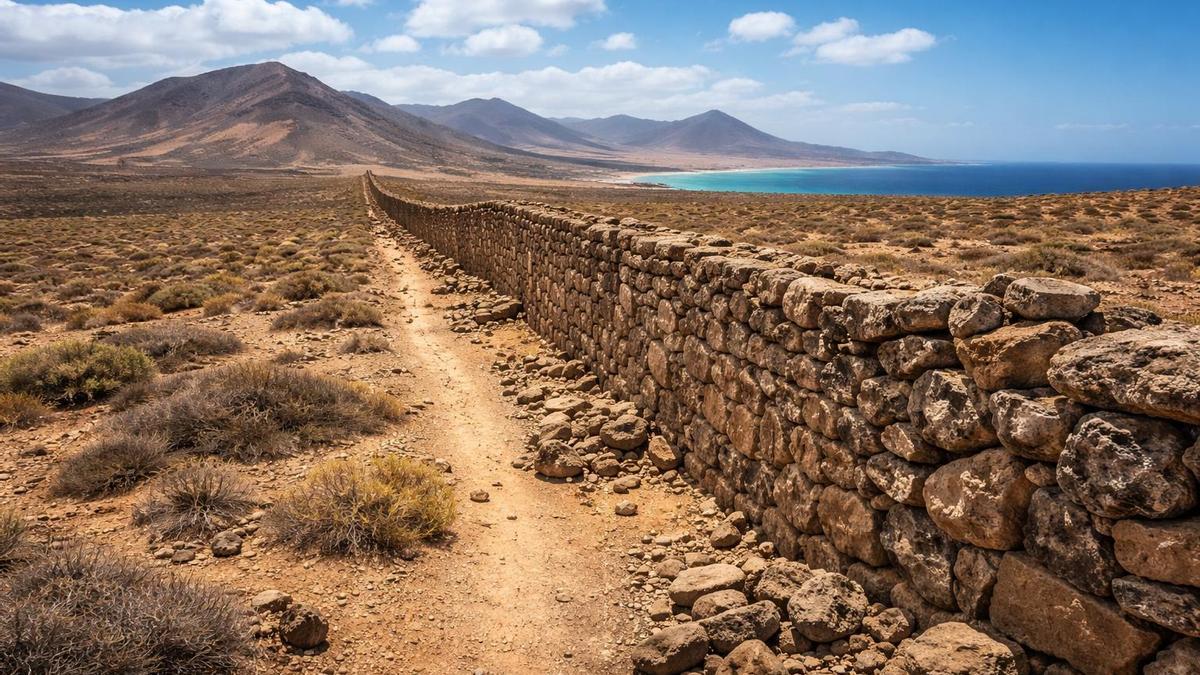
To prevent misunderstandings over resources like the local gofio (a traditional cornmeal), the inhabitants constructed a dry-stone wall stretching approximately six kilometers. While it wasn’t as grand as the Great Wall of China, the wall of Jandía served crucial territorial, political, and likely symbolic functions. Its construction reflects the organized society that thrived on the island long before European contact.
Historical Significance of the Jandía Wall
Today, remnants of this ancient wall still linger, particularly in the area aptly named La Pared. Archaeological studies by institutions like the Cabildo de Fuerteventura and the Museo Arqueológico de Fuerteventura reveal that the wall was built using local volcanic stones, showcasing the pre-Hispanic Canarian architectural techniques. This structure was not merely a boundary; it also controlled the movement of people and livestock, functioning as a frontier without the need for stamps or passports.
The Kings, Guise and Ayoze: Early Leaders
The names Guise and Ayoze are not mere figments of fiction; they appear in historical documents from the 15th century. Scholars from institutions such as Universidad de La Laguna have studied these figures, presenting them as representatives of differing power structures within a shared geography. The wall epitomized this division, acting as a clear political boundary: “You govern here; I govern there.”
A Debate in Archaeology
The exact chronology of the Jandía wall remains a subject of scholarly debate. Some experts argue for a clearly pre-Hispanic origin, while others consider the possibility of later modifications, especially following European conquests. Collaborative studies, including those conducted by the CSIC (Spanish National Research Council), have added depth to our understanding of pre-Hispanic settlement in Fuerteventura.
A History of Recycling: From Wall to Materials
As centuries passed, the Jandía wall gradually faded in significance. With the shifting societal needs, the stones from the wall were repurposed for new constructions—homes, corrals, and agricultural spaces. This historical recycling illustrates a common trend across Canary Islands and global histories.
Preservation: A Modern Context
In contemporary times, the remnants of the Jandía wall are incorporated into hiking routes and protected natural spaces. Walking alongside the wall offers a journey through the epochs, with Fuerteventura’s winds whispering the stories of yesteryears while reminding us of the island’s storied past.
Responsible Tourism and Conservation
Organizations like the Patronato de Turismo de Fuerteventura emphasize the importance of preserving this archaeological heritage, advocating for responsible tourism that respects the island’s historical significance. Promoting awareness discourages visitors from taking souvenirs, echoing a sentiment of preservation rather than depletion.
Echoes of a Divided Past
Discussing the Jandía wall goes beyond ancient history; it opens a dialogue about how the past shaped the lives of Fuerteventura’s early inhabitants. Evidence of two distinct realms underscores the island’s dynamics, reminding us that Fuerteventura is not merely a uniform paradise but rather a place of rich cultural and historical tapestry.
As Fuerteventura embraces its modern identity through promotional platforms showcasing sandy beaches and tranquility, it’s essential to remember that beneath this idyllic veneer lies a profound narrative. The wall represents more than just a division; it serves as a testament to the island’s identity, bridging the past with the present in ways that resonate with the local culture.
Amid selfies and sunbathing, the Jandía wall remains a poignant reminder of our shared heritage—an enduring legacy worth exploring for generations to come.