Market Reactions to Federal Reserve’s Interest Rate Speculations
Overview of Recent Market Movements
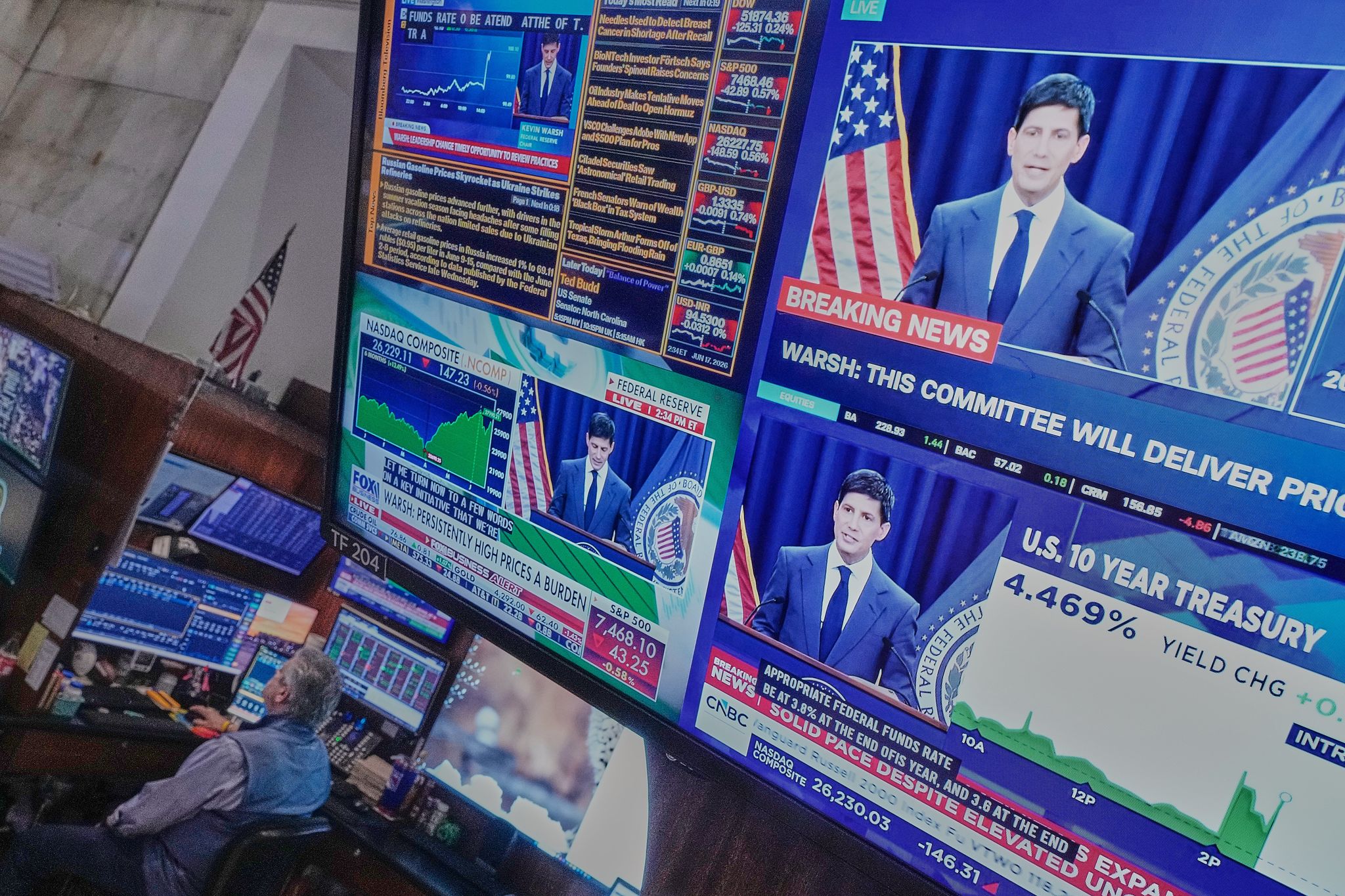
On June 17, 2026, U.S. stock markets experienced a notable decline, primarily driven by speculation surrounding potential interest rate hikes by the Federal Reserve. The S&P 500 index fell by 1.2%, while the Dow Jones Industrial Average and the Nasdaq composite also saw significant drops of 1% and 1.3%, respectively. This downturn came after the Federal Reserve released projections indicating that nearly half of its policymakers foresee at least one increase in the main interest rate within the year.
The Federal Reserve’s Projections
The Federal Reserve’s latest projections revealed that nine out of 18 policymakers anticipate raising the federal funds rate at least once before the year concludes. This news sent ripples through the financial markets, causing the S&P 500 to erase earlier gains and the Dow Jones to shift from a 0.5% increase to a 1% decline. The uncertainty surrounding interest rates has historically led to volatility in stock prices, as investors weigh the implications of higher borrowing costs on economic growth.
Chairman Kevin Warsh’s Press Conference
In his inaugural press conference as the head of the Federal Reserve, Chairman Kevin Warsh addressed the market’s concerns directly. He emphasized a potential shift in how the Fed communicates its policies, suggesting a departure from the traditional “forward guidance” approach. This method, which often hints at future interest rate movements, may be replaced with a more data-driven communication style. Warsh expressed a desire for Wall Street to react to economic data—such as inflation and employment figures—rather than speculating on the Fed’s future actions.
Impact on Treasury Yields
Following the Fed’s announcements, Treasury yields saw an uptick, reflecting rising expectations for interest rate hikes. The yield on the 10-year Treasury rose to 4.48%, while the two-year Treasury yield, which closely tracks Fed actions, climbed to 4.20%. These increases in yields can have a cascading effect on various loans, including mortgages, thereby influencing consumer spending and overall economic activity.
Market Reactions and Investor Sentiment
Investor sentiment appeared uneasy in the wake of the Fed’s projections. Stocks fluctuated throughout the day, reflecting the market’s uncertainty about the future direction of interest rates. Notably, SpaceX, which had recently debuted on the U.S. stock market, saw its shares drop by 3.3%, overshadowing positive earnings reports from other companies like La-Z-Boy, which experienced a 15.2% surge in its stock price.
Broader Economic Indicators
Despite the stock market’s decline, a report released on the same day indicated that retail revenues across the country grew at a faster pace than economists had anticipated. This suggests that consumer spending remains robust, which could provide some support for the economy amid rising inflation concerns. However, high inflation continues to weigh heavily on consumer sentiment, making many shoppers feel more cautious about their financial situations.
Global Economic Context
On the international front, oil prices stabilized following sharp declines earlier in the week, driven by optimism regarding a potential U.S.-Iran deal that could restore oil flow through the Strait of Hormuz. The price for a barrel of Brent crude rose to $79.55, still significantly lower than the $100-plus mark seen in previous weeks. This development could alleviate some inflationary pressures, providing a glimmer of hope for consumers and investors alike.
International Market Movements
Globally, stock markets exhibited mixed results. In Europe, London’s FTSE 100 saw a slight increase of 0.1%, buoyed by a report indicating that U.K. inflation remained steady at 2.8% in May. Meanwhile, South Korea’s Kospi index jumped by 1.6%, contrasting with Hong Kong’s Hang Seng, which fell by 0.7%. These fluctuations underscore the interconnectedness of global markets and the varying economic conditions across different regions.
Conclusion
As the Federal Reserve navigates the complexities of inflation and economic growth, market participants will continue to closely monitor its communications and policy decisions. The interplay between interest rates, consumer sentiment, and global economic conditions will remain pivotal in shaping the financial landscape in the coming months.