Fuerteventura Times – Business & Startups
Harnessing Growing Sectors for Sustainable Development
Fuerteventura is not just a sun-soaked paradise; it’s emerging as a dynamic hub for innovative business ventures. The island is witnessing a surge in sectors like tourism, renewable energy, and sustainable agriculture, presenting a fertile ground for startups looking to make their mark. The local government is actively investing in infrastructure and providing support for entrepreneurs, ensuring that Fuerteventura remains competitive on both national and international stages.
Tourism continues to be the cornerstone of the local economy, but efforts are ramping up to diversify income sources. Incentives for sustainable practices in hospitality are encouraging businesses to adopt eco-friendly measures, enhancing the island’s appeal amid increasing global demand for responsible travel. Additionally, with the increasing focus on local produce, agri-businesses are finding new channels for growth, tapping into the burgeoning market for organic and sustainably sourced food.
Equipped with modern facilities and an entrepreneurial spirit, Fuerteventura is poised to lead in renewable energy initiatives, particularly in solar and wind power. This not only reinforces the island’s commitment to environmental conservation but also attracts investments aimed at fostering innovative solutions. As these sectors evolve, the potential for collaboration among local and international startups is vast, offering a unique platform for growth and sustainability.
Source: Gobierno de Canarias
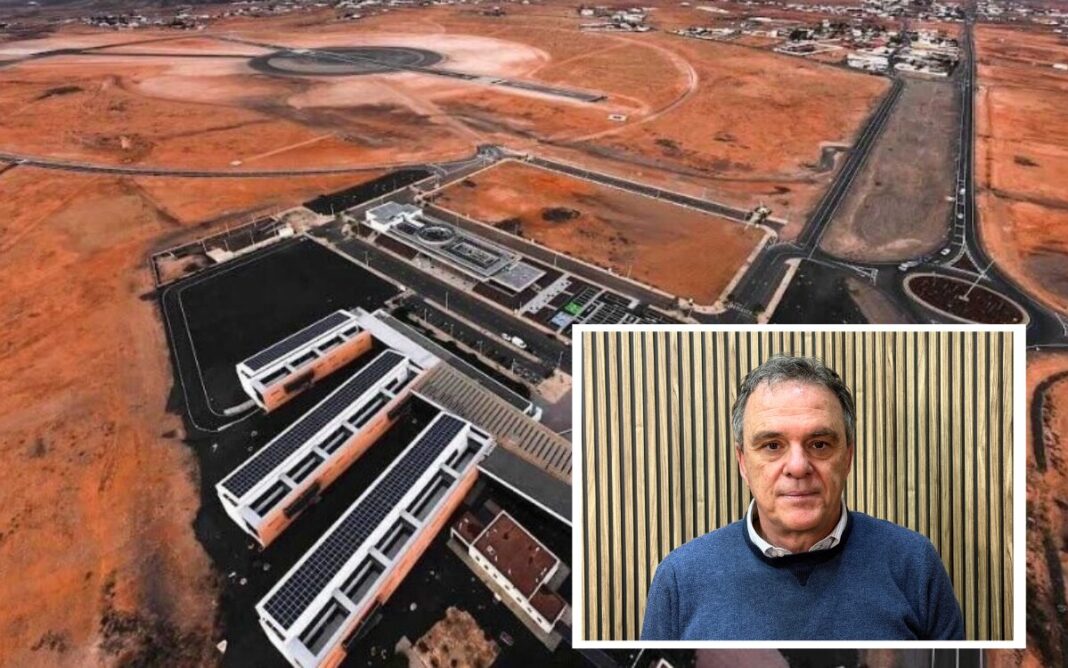
An “intrepid” idea, efforts and future The Fuerteventura Technology Park was born on a landfill after the old Los Estancos airport became inoperative. This is how the manager of the entity, Eduardo Pereira, remembers it in an interview on La Voz de Fuerteventura on Radio Insular where he explained that, then, there was no partnership, there was no team and there was no activity. Just an “intrepid” idea, as Pereira himself defines it, promoted in those years by the Island Council by some political leaders and some businessmen, such as Mario Cabrera, Juan Jesús Rodríguez Marichal or the late Andrés Valerón. “It was very hard,” he acknowledges, remembering the stage after the official inauguration, on November 12, 2014, of the archipelago’s first technology park. The easy thing, he explains, was to build the development and the buildings. The complicated part came later. It was necessary to provide content to a technological infrastructure on an island without a university, without a consolidated technological industry and with a society that asked itself, quite logically, “why had that been done?” Fuerteventura Technology Park in 2015 After a few years of hard work and uncertainty in which, he admits, he was afraid of not being able to sustain the project, the luck factor was put aside with the appointment of the current Minister of Territorial Policy, Territorial Cohesion and Water of the Government of the Canary Islands, Manuel Miranda, as general director of the Canary Islands Agency for Research, Information and Information Society. This is how Pereira explains it, remembering the intense agenda of meetings and meetings held at that time and highlighting one meeting in particular, which took place with the general director of Indra to try to attract activity to the Park. He told them that what Fuerteventura offered could also be offered by other destinations such as other Canary Islands, Cape Verde, Sicily or Singapore and invited them to look for their own, unique advantages that would make the difference. In this period, around 2018, the Fuerteventura Park added other specific singularities to its well-known advantages – such as the climate or a Special Tax Regime. Among them, extremely predictable weather, safe corridors to the sea, a small population under the test routes, a weaker jet stream around the Canary Islands and practically empty airspace to the southeast of the island; unique in Europe to test unmanned aerial systems. Geo Innovation Program 2023, the internationally recognized “Canarian initiative” Geo-Innovation 2030 was born from that reflection. The program was presented in June 2018 at the Telefónica Foundation, in Madrid. A day before, astronaut Pedro Duque was appointed Minister of Science and Innovation and attended the event. Another “stroke of luck,” Pereira smiles, highlighting that “where 40 companies were going to come, suddenly 200 appeared; where directors, let’s say intermediate directors, were going to come, the CEOs already came. And although they didn’t come for us, as I know, I say: it’s time to talk about our book.” In this context, the market consultation, promoted by this public body, received a response from a hundred companies and about 200 proposals. Afterwards, some 300 meetings and laborious work were scheduled to organize all that information and define what could really be done in Fuerteventura. The result today is an aerospace line that Pereira assures is a national and European reference. Not the Technology Park itself, he clarifies, but the Geo Innovation Program. It is “the Canarian initiative”, as it is known in the sector, which is linked to earth observation by combining satellite information with what high-altitude unmanned aircraft, such as drones or pseudo-satellites, can provide. As he explained, these systems can operate at about 20 kilometers altitude, remain over a specific area for much longer and obtain more precise and continuous information. This technology allows work in areas such as fire prevention, control of critical infrastructure, surveillance of natural spaces, marine pollution, illegal fishing or humanitarian care linked to migratory flows. A project recently presented in Gambia. Simulation in the Fuerteventura Technology Park Investment and real return The initial investment, Pereira recalled, was around 18 million euros, coming from European funds channeled through an agreement between the Government of the Canary Islands and the Ministry of Science and Innovation to create technology parks on the islands. Pereira insists that this money could not be used for health or other purposes, because they were finalist funds for technological infrastructure. “It came to us and we had left over,” he summarizes, recalling that part of the unexecuted money was returned, “about two million euros.” In total, he estimates that the Fuerteventura Technology Park has already mobilized more than 100 million euros between infrastructure, European projects and actions linked to the aerospace program. Of that amount, around 60 million would come from external funds, “mainly European, state and Canary Islands Government funds”, while the Fuerteventura Cabildo contributed around 40 million euros in 2020. Telespazio Ibérica and the Leonardo group sign an agreement to start working with the latest generation unmanned aircraft, Falco EVO, from the Fuerteventura Technology Park. As he explains, these 40 million are not exhausted in direct spending, but rather function as a lever to attend European calls and raise new funds. The usual model is that the Park co-finances around 15% of the projects and that the European Union contributes the remaining 85%. In this way, “with those 40 million (from the Cabildo), we are going to raise more than 200 million euros in actions.” It is the way, defends Pereira, to attract large companies, anchor them in Fuerteventura and favor the transfer to local SMEs, from technical services to networks, design, maintenance or operational support. PTFUE, pending authorization for the only aerospace ‘sandbox’ in Europe Companies such as Thales Alenia Space, Telespazio Ibérica, Magline, Atechsync, Skydweller or Aeromedia work in the Park, within the ecosystem linked to the Canary Islands Geo Innovation Program and the Fuerteventura Stratoport. Some with 15-year contracts. The Fuerteventura Technology Park hosts the first flight of a civil pseudo-satellite in Europe In this area aerospace, Pereira estimates that there are around 50 direct jobs, although he warns that the data changes rapidly. On the other hand, he explained, in the classic line of the Park there are more than twenty companies, linked to ICT, audiovisuals or innovation, with between “300 and 400 people working in the environment.” a quarry from which some of the established companies already draw. The idea is, he acknowledged, to continue investing in training. In the immediate future, Pereira recognizes that the great pending asset is the authorization of the airspace located in the southeast of the island as a unique aerospace sandbox in Europe to test unmanned systems from sea level to 20,000 meters. other organizations such as ENAIRE, AENA, AESA, the control tower and European entities to make the rules in this area more flexible and to be able to test prototypes and technologies that could not operate under the same requirements as a commercial aircraft. Interministerial Defense and Transportation Commission so “we hope this will be approved and published this year; I think sooner rather than later.” Self-criticism: lack of communication and the absence of a higher vocational training in the aerospace sector In the balance he does not hide self-criticism. Pereira admits that one of his mistakes has been communication. The Park, he affirms, has done many “big” things that it has not always known how to explain. For fear of announcing what could not later be fulfilled, they only communicated what was already “in the basket.” Now they try to promote closeness and knowledge of their activity, with open visits and programmed so that citizens can see, touch and understand what happens inside. “When someone comes, we tell them what we do and they see it, the perception changes completely,” he says, announcing that the visits will soon be opened to the general public. He also leaves pending Vocational Training linked to the aerospace sector. Pereira has been trying for two years to promote a higher education cycle in unmanned systems in Fuerteventura. more agile, “capable of responding to sectors that advance much faster than the administration.” In this line, he emphasizes the need to promote this training, either through formal training or through specific courses with the companies themselves. “It is true that it is not official training, but it is worth it if you have the training,” he points out. Majorero engineer David Díaz Martínez will be the new manager. After an extensive professional career at AENA and fifteen years at the Fuerteventura Technology Park, Eduardo Pereira is saying goodbye by personal decision. fatigue, the intensity with which the work is undertaken, the countless trips, the warning signs in the body and the need to close a stage in an orderly manner; paying special attention to the impact on the sector, for a time there will be a bicephaly in the Management that will allow the change to be completed and guarantee security in the replacement that will put Majorero Sergio David Díaz Martínez in charge. He is an aerospace engineer, trained at the Polytechnic University of Madrid, with a master’s degree in Design. Space Vehicles from the Luleå University of Technology, in Sweden, and a master’s degree in Public Procurement from the University of Castilla-La Mancha. He has been in the Park for five years and, as Pereira highlighted, he already assumes the burden of aerospace projects and represents the entity in international forums. Eduardo Pereira leaves, he says, with the satisfaction and peace of mind of leaving behind a “great team” of twelve people and a project with a future for a Park that was born in a landfill and that he aspires to. to be one of the most unique aerospace test areas in Europe.
Originally reported by www.lavozdefuerteventura.com, rewritten by the Fuerteventura Times AI Editorial Desk.