The Delicate Balance of El Saladar de Jandía: A Cultural and Environmental Insight
An Invasive Challenge: Arundo donax
Located on the stunning island of Fuerteventura, El Saladar de Jandía is a unique ecosystem facing a modern-day dilemma: the invasion of Arundo donax, commonly known as giant reed. This plant, while seemingly innocuous, is listed among the world’s top 100 invasive species by the International Union for Conservation of Nature. Its rapid expansion poses significant environmental challenges, threatening the delicate balance of this unique habitat while also endangering local infrastructure and commerce.
The problem lies in Arundo donax’s ability to form dense colonies that can grow up to six meters high. Such growth not only disrupts the native flora and fauna but also risks the flooding of nearby urban areas during heavy rains by blocking natural water channels, known as barrancos. To tackle this daunting challenge, the Cabildo of Fuerteventura initiated concerted efforts in December, marking the start of an intensive control program aimed at managing the spread of this invasive species.
The Control Initiative: A Collective Effort
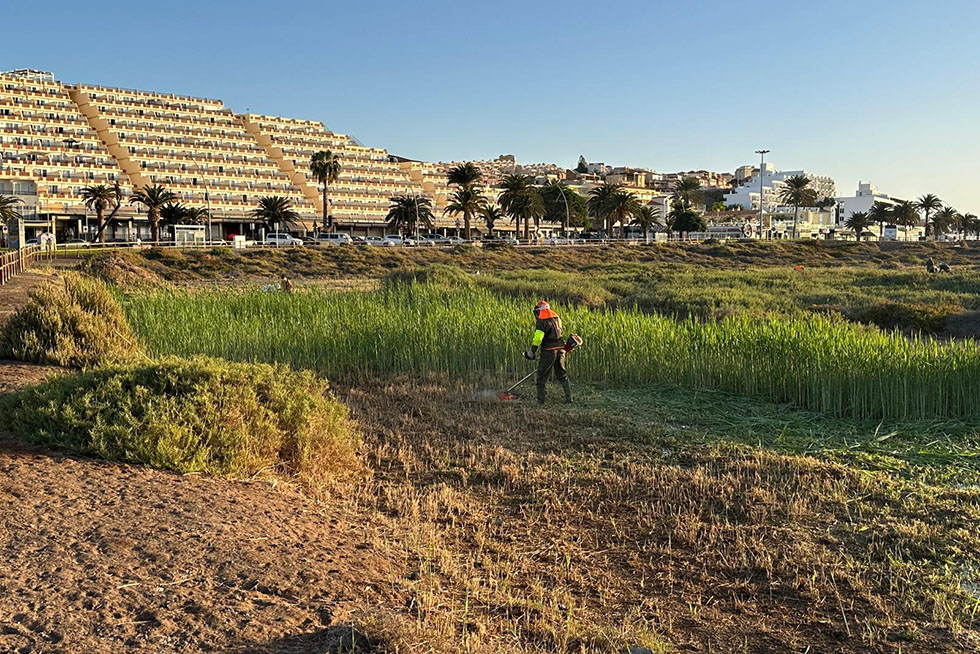
The program, titled “Fuerteventura, beautiful by nature,” embodies the local government’s commitment to environmental conservation. The Cabildo has sanctioned a range of small-scale projects to mitigate the issues caused by Arundo donax. Utilizing the resources from the Service of Works and Machinery and the Service of the Environment alongside the teams from Gestión y Planeamiento Territorial y Medioambiental (Gesplan), these efforts cover over 1,600 square meters in the western part of El Saladar de Jandía.
As part of the initiative, the first step involved extensive clearing work that successfully reduced the prevalence of Arundo donax in the targeted area. Following this initial “shock” treatment, a weekly monitoring routine has been established to ensure that the invasive plant does not regain control over the area. Lola García, the president of the Cabildo, notes the significance of this routine, emphasizing its role in protecting both the ecosystem and local infrastructure.
Ecological Importance of El Saladar de Jandía
El Saladar de Jandía is not only critical for its biodiversity but also serves a significant role in the local economy. Designated as a protected natural area by the Government of the Canary Islands in 1994, it represents the last viable example of a coastal halophytic shrubland in the archipelago. This ecosystem is uniquely adapted to handle periodic flooding caused by tidal movements, showcasing nature’s resilience.
The interplay of tidal forces leads to fascinating phenomena within the saline ponds formed during high tide, where seawater can flood areas far from the coast, transforming them into temporary salt marshes. This cycle enriches the habitat, supporting various species and demonstrating the ecological importance of the wetland.
Threats Beyond Invasion: Climate and Urban Pressure
While the invasive nature of Arundo donax is a pressing concern, other factors also contribute to the vulnerability of El Saladar de Jandía. Climate change poses a considerable risk, altering rainfall patterns and exacerbating flooding risks. Alongside urban development pressures, these factors threaten both the ecological integrity of this unique wetland and the livelihoods of local communities reliant on its health.
The Cabildo’s proactive measures are, therefore, crucial. Restoration and preservation efforts not only combat the invasive species but also focus on strengthening the overall resilience of the ecosystem. By addressing both environmental degradation and infrastructure risks, these initiatives embody a holistic approach to conservation that could serve as a model for other regions facing similar challenges.
Community Involvement and Education
Local community involvement is another key aspect of the initiative to keep Arundo donax at bay. Engaging residents and local businesses in awareness campaigns about the ecological importance of El Saladar de Jandía enhances community stewardship. By promoting sustainable practices and encouraging responsible tourism, the Cabildo aims to cultivate a sense of ownership among locals in the preservation of their natural heritage.
Educational programs seek to inform both residents and visitors about the delicate balance that sustains this unique ecosystem. Understanding the mutual dependence between the health of El Saladar de Jandía and economic stability reinforces the idea that environmental conservation is a collective responsibility.
Through these multifaceted strategies, the challenges posed by Arundo donax and other ecological threats are being met with determination and ingenuity, ensuring that El Saladar de Jandía retains its status as a natural wonder and a vital resource for generations to come.