El Hotel Tres Islas, a prominently located establishment on the stunning Dunas de Corralejo, is facing imminent closure. The central government has finalized the caducity dossier for its concession to occupy public land, a permit that was originally granted in April 2007. Following this decision, an order has been prepared for the demolition of this hotel, owned by the renowned RIU chain.
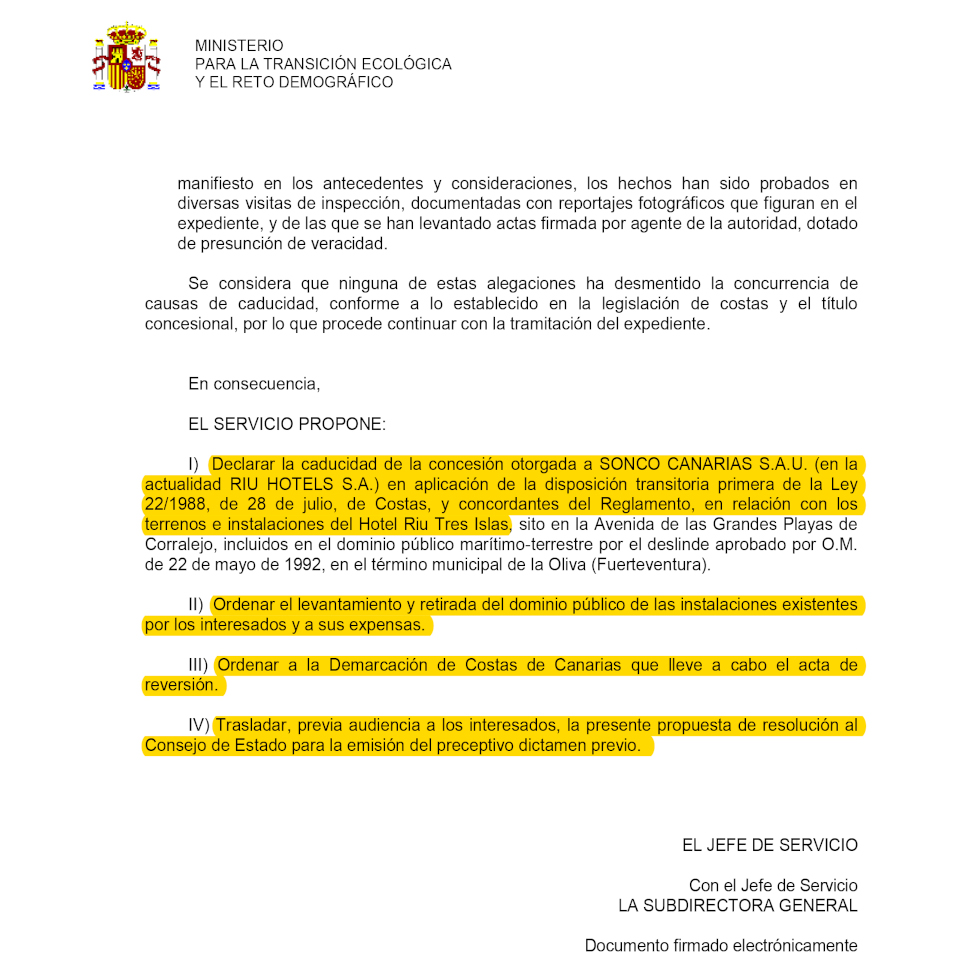
A comprehensive proposal from the Ministry for Ecological Transition, which has been obtained by Diario de Fuerteventura, outlines that the government intends to not only order the removal of the hotel from public domain but also to have the Canary Islands Coastal Demarcation restore the land to state ownership. This proposal has received backing from the Secretary of State for the Environment, Hugo Morán, confirming the gravity of the situation.
Recently, the Ministry has taken the final step in the process by receiving endorsements from both the Council of Public Works and the State’s Attorney’s Office. The caducity of the concession has now been submitted to the State Council, awaiting its advisory verdict. This step is significant as it marks the culmination of efforts to enforce adherence to environmental regulations and uphold the integrity of the land’s usage.
The precedent of revoking concessions within the dunes was previously suggested by the State Council concerning RIU’s other establishment, the Oliva Beach hotel. This had come about when the central government initiated a review of the permission, which was eventually archived due to the expiration of the regulatory timeframe. In contrast to this previous instance, the current caducity focuses solely on the company’s violations rather than governmental oversights.
The Secretary of State has validated the resolution proposal to revoke the concession.
El Hotel Tres Islas, conceived by architect Miguel Fisac and constructed between 1970 and 1973, is not alone in facing scrutiny; the Oliva Beach Hotel, designed by Fernando Higueras, also has an active caducity process against it. The investigation into Tres Islas began in August 2021, revealing a long-standing pattern of regulatory infractions.
In April 2007, Sonco Canarias, later absorbed by RIU, received a 30-year concession on the Tres Islas, covering around 40,000 square meters—until 2037—without the possibility of extension. This concession authorized rehabilitation and maintenance efforts, yet RIU went beyond this scope. By April 2008, the Coastal Demarcation began proceedings for sanctioned infringements, specifically an unauthorized expansion of the hotel’s volume, clearly prohibited by both legislation and the concession terms.
This violation resulted in a penalty of 10,885 euros and an order to remove unauthorized constructions within 30 days. Despite this, RIU failed to comply.
By February 2020, amidst ongoing controversies regarding the hotels in the dunes, inspections revealed that the illegal construction that had expanded hotel volume remained unaddressed. Subsequent efforts by the Ministry in March 2020 pressed RIU to execute the demolition of four newly constructed rooms; however, when re-inspected in June, it was evident that no action had been taken.
The Ministry has called for the “removal and withdrawal” of existing installations.
This lack of compliance initiated further inspections, leading to an official record in August confirming all existing constructions and usages on the public domain grounds. It was discovered that the actual area of occupation was 29,600 square meters, highlighting both new and unauthorized installations that appeared after the concession was granted.
Among these was a substantial increase in height—five meters in total—that caused shading over adjacent structures and communal areas, indicating unauthorized commercial exploitation by RIU and subsequent financial gain from illegal developments.
The Ministry has been particularly critical concerning the poor imitation of Fisac’s original modular plate aesthetics meant to cover the building’s facade, a notable architectural feature of his work.
Additional inspections yielded more irregularities, such as unauthorized interior modifications across 1,900 square meters, including the construction of SPA facilities and new pools, also lacking the necessary permissions. Alarmingly, a desalination plant and a wastewater treatment facility in disrepair were identified, discharging untreated waste into the sea, raising significant environmental concerns.
RIU’s refusal to demolish the four unauthorized rooms led to the discovery of more unpermitted works.
In its resolution proposal, validated by the Secretary of State, the Ministry asserts the unauthorized surface increases from these operations total 1,031.4 square meters, with the illegal volume amounting to nearly 3,000 square meters. These violations are deemed severe enough to warrant the caducity of the concession. The initial agreement clearly prohibited construction beyond repair and improvement, specifically against any increase in volume or height without prior authorization.
Despite RIU’s defense claims—arguing their actions led to less than a 10% volume increase and questioning the competence of the Coastal Demarcation—the Ministry dismissed all allegations, emphasizing their statutory obligations to pursue concession invalidation. The argument about volume increase not exceeding 10% was clearly countered by the assertions that such limits do not apply to protections in cases like Tres Islas and similar concessions.
Additionally, the unauthorized transition of the concession from Sonco Canarias to RIU further complicates matters, making it another possible ground for caducity of the permit.
The government of the Canary Islands attempted to halt the expediting processes involving the dunes.
Moreover, the regional Ministry of Ecological Transition participated in the proceedings, emphasizing the recent transfer of coastal management powers from the central government to the autonomous community. They urged national authorities to reconsider proceeding in controversial areas involving the hotels within the dunes.
However, the Ministry maintained a firm stance on this issue, clarifying that while general coastal concessions may fall under the purview of the regional government, exceptional cases like Tres Islas and Oliva Beach possess distinct transitional criteria that necessitate federal oversight and management, particularly in light of the original boundaries established in 1992. Such concessions remain under the state’s jurisdiction, ensuring their authority over coastal management matters that transcend the devolution of administration to regional governments.