Uncovering Ancient Secrets: The Roman Archaeological Excavations at Lobos Island
Recently, an exciting chapter in archaeological research reached a milestone: the latest excavation campaign at the Roman site on Lobos Island has successfully concluded. This endeavor is part of a broader research initiative titled “Towards the Definition of the Purpura Islands: From the Purple Workshop of Lobos 1 (islet of Lobos, La Oliva, Fuerteventura). Archaeological Work in Lobos Islet and its Immediate Territorial Context.”
Collaboration and Research Context
The excavation project benefits from a Collaboration Agreement between the Cabildo of Fuerteventura and the Autonomous Organism of Museums and Centers, co-led by researchers from both institutions along with the University of La Laguna. This collaboration works with a diverse interdisciplinary team, bringing together expertise across various fields, enhancing the overall depth of investigation.
Focus of Excavation Campaign
During the November-December 2022 campaign, the primary focus was to continue the excavation at Lobos 1, recognized as a Roman purple workshop from the late republican and early imperial periods. This workshop was critical for producing purple dye, a luxurious hue highly sought after in ancient Rome. The aim of the campaign was to define the extent and occupation of the southern area of the site—essentially unraveling the threads of history woven into the fabric of Lobos Island.
The Significance of Purple Dye
Purple dye, derived from marine mollusks of the Muricidae family, was a status symbol in Roman culture. The dye process originated from Stramonita haemastoma, along with traces of Hexaplex duplex. The remnants of these mollusks at Lobos have been documented in concheros, showing over 98% representation alongside other marine species. Archaeological evidence indicates that the extraction involved careful techniques to preserve the valuable secretion found in the mollusk’s gland, followed by a complex cooking process in lead cauldrons.
Tools and Daily Life of Dye Workers
The excavation revealed tools essential to the purple dye production, such as broad basalt anvils and percussion hammers. Fragments of iron blades, likely used as knives, along with combustion structures and remnants of lead cauldrons, further illustrate the craftsmanship of these ancient artisans. Moreover, the discovery of additional spaces signals that these workers were not solely dedicated to dye production. Evidence points to various marine resource exploitations, such as fishing and shell-fishing activities, supported by specialized instruments including hooks and copper sewing needles for nets.
Insights into Daily Life
This year’s excavations highlighted an area that served as a significant refuse dump, preserving fragments of daily life. Notable findings included an abundance of sheep and goat remains, along with traces of fish and mollusks, emphasizing the dietary habits of the inhabitants. Ceramics, ranging from amphorae to cooking ware and lamps, were also uncovered, alongside metallic artifacts and fishing tools like stone and lead net weights, sharpening our understanding of their daily routines.
In proximity to this waste area, researchers identified a gathering of muricids representing the 7th conchery of the site. This was associated with a sediment layer showcasing deep violet coloration and calcareous nodules, indicating a history of dye processing and subsequent cleanups. The full extent of this area remains to be explored in future excavation efforts, including the potential architectural features of what appears to be a 7-meter-long wall.
Future Excavation Excitement
Looking ahead, the enthusiasm among the research team is palpable. There is an eager anticipation for the next excavation campaign, promising further exploration to uncover the southern expansion of this ancient settlement. Such investigations hold great potential for revealing more about the daily lives, economic activities, and cultural significance of the purple dye workshops, along with broader insights into the island’s historical role during Roman times.
This rich tapestry of archaeological work at Lobos Island continues to shine light on the intricate connections between ancient craftsmanship, trade, and daily life, forming a compelling narrative of cultural heritage waiting to be fully understood.
Credits
Text: Mercedes del Arco Aguilar (Museo Arqueológico de Tenerife), Carmen del Arco Aguilar (Universidad de La Laguna), Isidoro Hernández Sánchez (Museo Arqueológico de Fuerteventura), project directors.
Photography: C. del Arco
Photo Captions
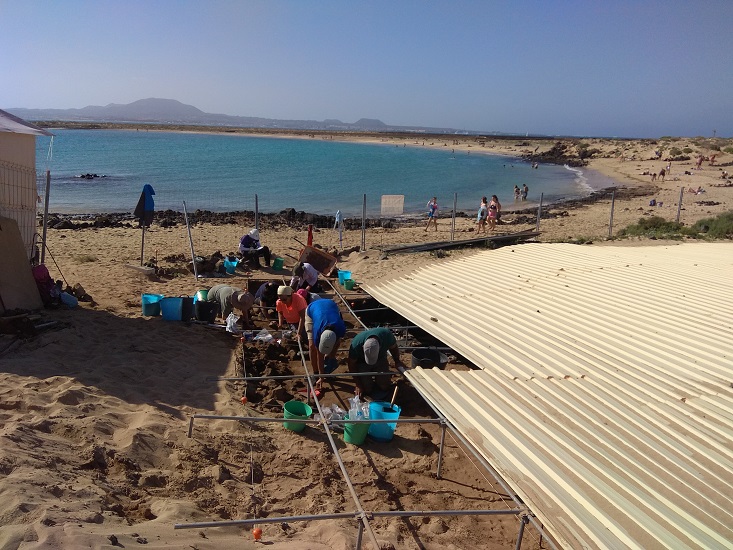
Fig. 1: Playa de la Calera (islote de Lobos), with the location of the Lobos 1 site in the background.
Fig. 2: Excavating in Lobos 1 during the 2022 campaign.
Fig. 3: Area adjacent to the conchery displaying violet sediment and calcareous nodules, due to purpura residue deposit.
Fig. 4: Adjacent area showcasing the same purpura residue characteristics.
Fig. 5: Beginning area of the conchery, featuring a basalt anvil.
Fig. 6: Remains of sheep and goat bones.
Fig. 7: Fragmented amphora.