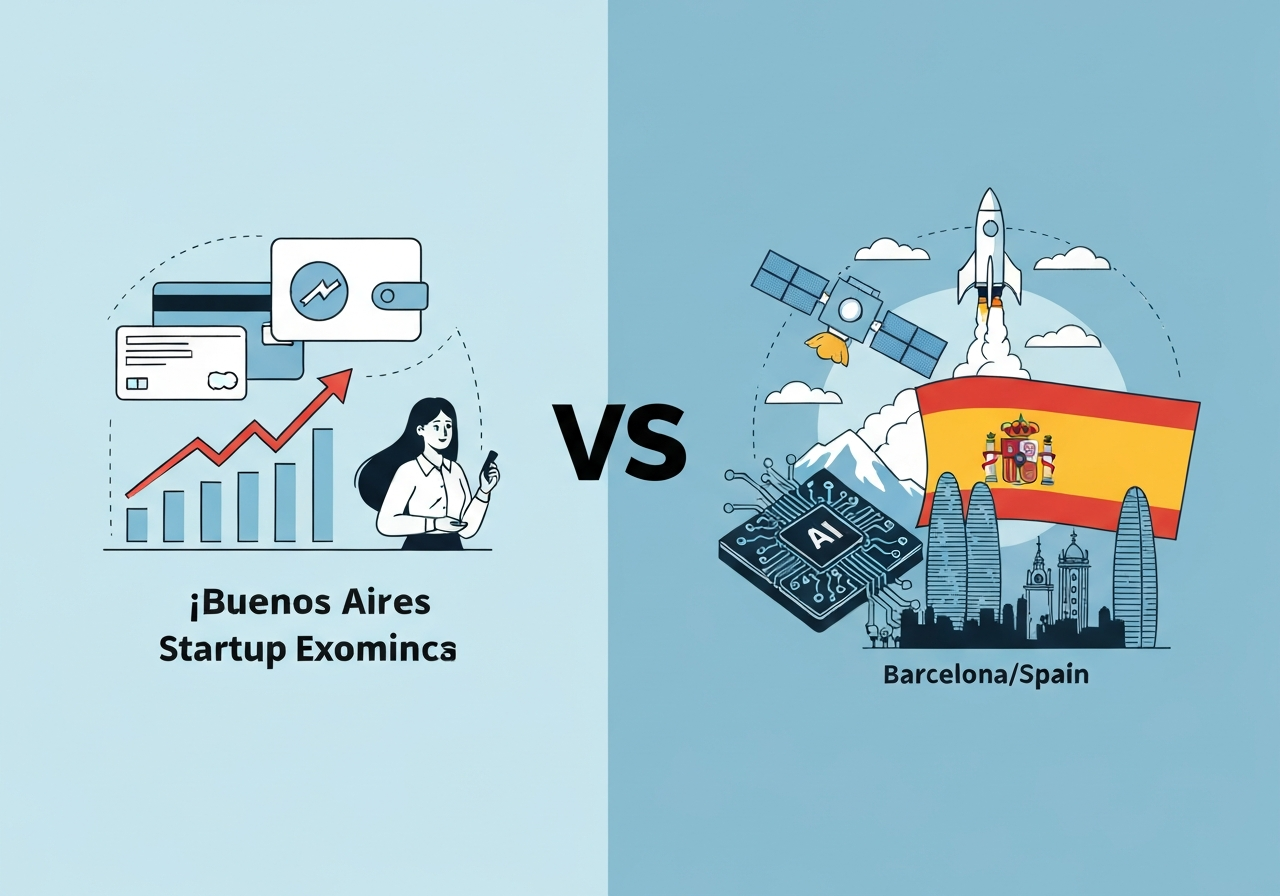
Spain and Argentina may be household names on the football pitch, but in the global race for venture capital, they remain relative ‘underdogs.’ Recent funding rounds suggest both ecosystems are sharpening distinct competitive edges, making them intriguing for global investors looking for the next wave of ‘liquidity inflow’ outside the usual hubs. As we delve into the latest deal flow, it becomes clear that Argentina is leaning into financial infrastructure and consumer fintech, while Spain is building momentum around aerospace ambitions and enterprise AI.
Argentina: A ‘Small but Durable’ Fintech Engine
Argentina’s venture market, while smaller than regional heavyweights like Brazil and Mexico, has shown remarkable resilience. Typically attracting only several hundred million dollars annually, it has still produced outsized success stories that stand as beacons of potential in a landscape often marred by volatility and macroeconomic uncertainty. One of the most notable examples is MercadoLibre ($MELI), the Latin American e-commerce and fintech giant that began as a garage startup in Buenos Aires and is now headquartered in Uruguay. With a market capitalization of approximately $94 billion, MercadoLibre exemplifies Argentina’s ability to generate globally scaled outcomes despite limited domestic funding depth.
In 2026, attention has shifted to Buenos Aires-based fintech Ualá, which has raised a total of $1.1 billion to date. In March alone, the company secured $195 million, reinforcing a broader trend: the largest Argentine funding rounds are clustering around payments, collections, and embedded finance infrastructure. Payment infrastructure startup Pomelo raised $55 million in its Series C, co-led by Kaszek and Insight Partners, while Tapi, another payments and collection infrastructure firm, brought in $27 million in a February Series B. Market participants note that Argentina’s annual totals can swing sharply depending on whether one or two mega-rounds land in a given year. Yet, 2026 funding is already tracking above last year’s full-year performance, highlighting a renewed investor willingness to back category leaders.
Spain: Smaller Totals, Bigger Bets on Space and AI
Spain’s startup funding, while trailing larger European peers, is increasingly characterized by sector specialization rather than sheer volume. In 2026, Spanish startups have raised less than $2 billion across stages—about one-third of France’s total over the same period. However, the year’s largest round went to PLD Space, a space company that raised $206 million in a March Series C. Positioned as a ‘global space transportation service provider,’ PLD Space supports missions tied to lunar and Martian exploration, aligning Spain’s venture narrative with broader global interest in sovereign launch capabilities and commercial space logistics.
Barcelona-based Factorial, an AI-enabled HR and payroll management platform, also secured significant financing in June, raising $150 million in a Series D at a reported $2.5 billion valuation. With cumulative equity funding exceeding $350 million, Factorial illustrates the growing investor appetite for enterprise software platforms that can scale beyond domestic markets. Madrid-based firms have added to this momentum, with EOS-X Space, focused on near-space infrastructure and space tourism, raising $140 million in a May Series D. Meanwhile, Zummit, an AI tools developer for geospatial data analysis, closed a $130 million Series B in April, reflecting continued demand for applied AI in mapping, climate, and infrastructure intelligence.
Over the past several years, total annual venture investment in Spain has generally ranged between $1.8 billion and $2.8 billion. With 2026 deal activity expanding, analysts expect the country could close the year with a stronger showing than 2025, even if it remains a secondary market compared to the continent’s largest hubs.
Underdogs with Distinct Identities
Despite their cultural prominence and deep talent pools, Spain and Argentina remain outside the top tier of venture destinations. The macro backdrop is not especially favorable; global capital has become more selective, and the AI cycle has intensified winner-takes-most dynamics that funnel funding toward established ecosystems. Yet, the latest funding patterns suggest each market is developing a clearer identity—Argentina as a fintech proving ground and Spain as an emerging European node for ‘space commercialization’ and applied AI.
If global venture capital broadens its geographic aperture in the coming quarters, both ecosystems could benefit disproportionately, supported by visible success cases and increasingly mature founders. Recent activity underscores a familiar venture truth: while scale matters, focus matters too. In markets where the pool of capital is smaller, the ability to concentrate resources on a few defensible sectors—and produce repeatable breakout outcomes—can become the foundation for the next phase of growth.