Juan Cabrera Justifies His “Betrayal” Amid Breach of Pact
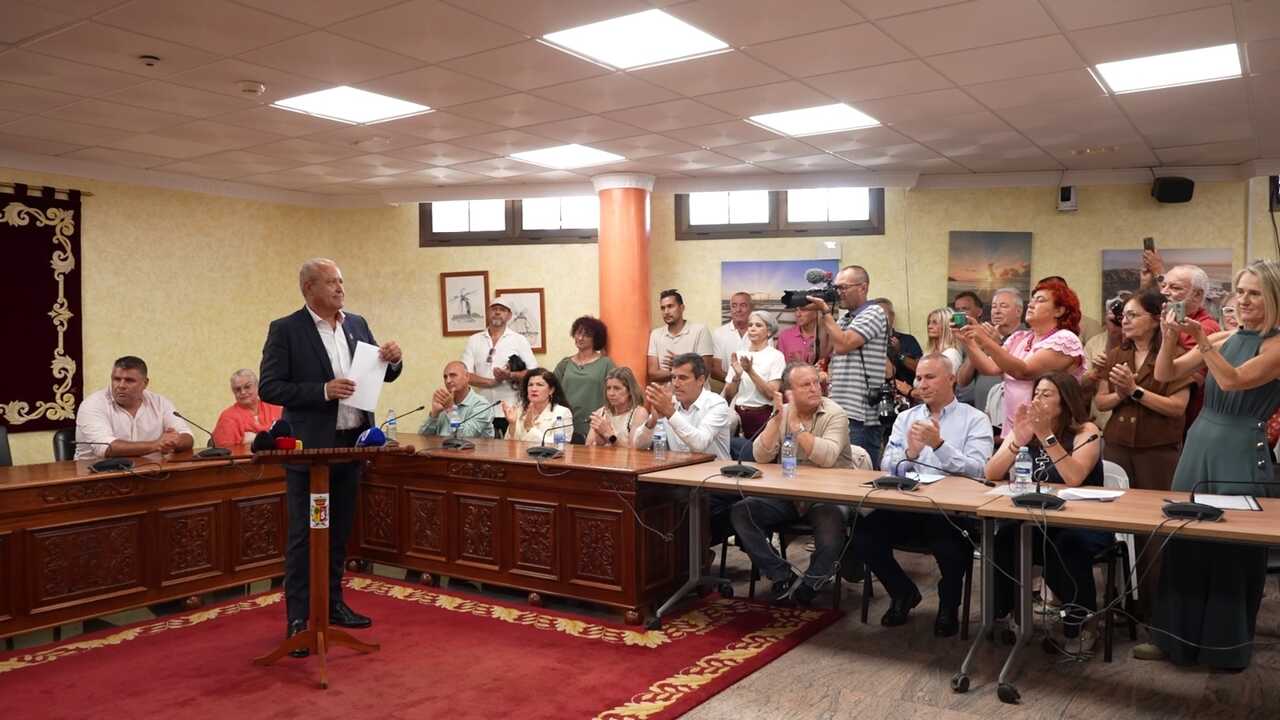
Juan Cabrera, a prominent figure from the Asambleas Municipales de Fuerteventura (AMF), has come forward to defend his recent split from Matías Peña, the outgoing mayor, addressing accusations of “betrayal” made in Peña’s farewell letter. Cabrera’s remarks shine a light on the recent legislative discord, revealing underlying tensions that have colored the political landscape of Antigua.
Background of the Agreement
Cabrera emphasized that disagreements within the coalition began from the very start of the mandate. Initially, he recounted that the agreement was primarily between AMF and ALxAn, creating a stable governing coalition comprised of nine councilors. However, the dynamics shifted dramatically when Peña unilaterally invited members from the Socialist Party (PSOE) and Coalición Canaria into the local government without consulting his partners. This maneuver inflated the governing body to fifteen councilors, quite contrary to the original pact.
Cabrera’s frustration stems from the financial implications of this decision. “Fifteen councilors out of seventeen receiving salaries is outrageous,” he stated, pointing to the potential waste of resources. “That’s €250,000 a year; a million euros over a single legislative term could easily repave our roads,” he added, underscoring the financial irresponsibility he perceives in Peña’s expanded cabinet.
Unfulfilled Promises
The newly elected mayor further articulated his rationale for supporting a motion of no confidence against Peña, specifically highlighting what he termed as Peña’s “incumplidor” (non-compliant) governance. Cabrera raised the issue of a purported agreement to rotate the mayoral position halfway through the term, claiming that he should have assumed the mayoralty a year prior.
One instance Cabrera cited was the controversial dismissal of a staff member responsible for services related to parks and gardens, someone he regarded as dedicated and well-respected within the community. Cabrera accused Peña of overstepping his bounds by removing competencies from Agustín Rodríguez, another AMF councilor, intensifying tensions within the coalition.
Matías Peña’s Counterarguments
In response, Matías Peña has stood firm, asserting that his pact was explicitly with Agustín Rodríguez and not with Cabrera. “The agreement was made clearly with Agustín, and there was uncertainty about Juan’s inclusion,” Peña remarked, suggesting the initial terms of collaboration were not as straightforward as Cabrera contends.
Peña also defended his administration against the accusations related to budgetary mismanagement, particularly concerning the events department previously led by Rodríguez. He indicated ongoing fiscal challenges but added that there were pending payments that had contributed to the problematic financial landscape.
Political Dynamics and Coalición Canaria’s Critique
The opposition leader from Coalition Canaria, David Alberto Guerra, took a severe stance against Peña’s leadership. He attributed the motion of no confidence to a perceived lack of direction in local governance, declaring it an era defined by “blockage and mismanagement.” Guerra criticized Peña’s “presidentialism,” suggesting that his administration’s approach has stifled collaborations crucial for the municipality’s development, leading to significant missed investment opportunities.
Moreover, Guerra highlighted the alarming reduction in the local police force over the years, indicating a deteriorating public safety situation. “There are nights when there’s not a single local police officer on duty,” he lamented, arguing that the community deserves better.
The Role of Other Political Parties
As the political turmoil unfolds, representatives from other parties, including the Popular Party and Contigo, have voiced support for the motion of no confidence, framing it as a necessary step to reclaim effective governance. Joana Verde from the Popular Party insisted that responding to citizens’ needs involves forming a new governing majority that prioritizes efficient management.
Giuseppe Signorino from Contigo stressed that the democratic process is at the heart of this motion, stating, “The people elect the councilors, and those councilors elect the mayor,” emphasizing the importance of accountability in local governance.
Perspectives from the PSOE
The Socialist Party’s representative, América Soto, acknowledged the procedural legitimacy of the no-confidence motion but expressed disappointment in the underlying motives. She urged that true governance is reflected in daily work and community benefits, asserting that progress had been made in various social initiatives, including educational support.
Concluding Remarks on Political Landscape
As the political tension between Cabrera and Peña continues to unfold, the ramifications of these disputes could shape the future of Antigua’s governance. The public is left to navigate not just the present challenges but also the commitment each political faction exhibits towards rebuilding trust and facilitating effective management in their town.