markdown
Un Veedor en el Patrimonio de Fuerteventura: Francisco Galante
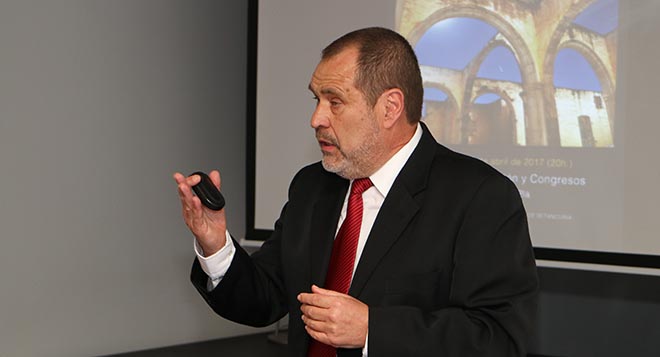
Francisco Galante, renowned professor of Art History at the University of La Laguna and an academic consultant at the University of Louvain in Flanders, Belgium, has dedicated a significant portion of his career to the exploration of Fuerteventura’s artistic heritage. His research particularly revolves around the Virgen de la Peña, alongside other intriguing themes such as the Christ of La Laguna, the artistic exchanges between Flanders and the Canary Islands, and the architectural legacy of César Manrique. Recently, he delivered a thought-provoking lecture in Fuerteventura titled “Betancuria, its Convent, and the First Images in the History of Art in the Canary Islands.”
In this lecture, he focused on the Franciscans’ convent, a derelict building that stands as a testament to the region’s rich history, and on the ongoing discussions regarding future restoration initiatives, including the controversial notion of covering the ancient church. Galante firmly believes that the convent should be protected by consolidating its ruins rather than obscuring them with a roof.
The Historical and Artistic Significance of the Betancuria Convent
The Betancuria convent marks the emergence of large-scale monastic architecture in the Canary Islands, even though earlier, less significant monastic buildings had been constructed. From an art history perspective and other humanistic disciplines, the convent of San Buenaventura holds considerable weight in the region’s 15th-century history. The introduction of the Franciscans to Betancuria, facilitated by the papal bull Pia Fidelium from Benedict XIII (the “Antipope”), on April 1, 1416, was pivotal for the cultural and spiritual evolution of the Canary Islands.
Among the notable figures associated with this convent were the Minorite San Diego de Alcalá and the theologian Fray Juan de Santorcaz, who closely followed the teachings of Ramón Llull, a major intellectual figure of that era. Written works by Llull found a home in the Betancuria convent’s library, showcasing its connection to Western culture. The earliest inventory of the convent, dating to the late 17th century, references an extensive collection of images, including a Crucifixion piece preserved in the baptistery of Betancuria’s church and the highly regarded Virgin of Consolation, noted as the oldest in the Canary Islands. Many artworks from the convent were redistributed in the 19th century following disamortization laws, with the convent serving as the pinnacle of religious art in Fuerteventura until then.
The Virgin of la Peña: A Controversial Heritage
In 2006, Galante was the pregonero (herald) for the festivities of la Peña, after which he authored the book La Virgen de la Peña: A Pregon in Her Sanctuary, linking the statue to the Flemish workshops of the “Maestro de Rímini.” However, some sectors continue to associate it with the image supposedly brought by the conqueror Jean de Béthencourt from France in 1402.
“I find it erroneous to connect the Virgin of la Peña with anything related to Béthencourt’s journey,” Galante asserts, emphasizing that recent scholarly contributions and research validated by esteemed European experts have illustrated the alabaster sculpture’s actual origins. Crafted between 1430-1440 under the aesthetic ideals shaped by early Flemish painters, particularly Roger van der Weyden, the Virgen de la Peña has no affiliations with French or Norman sculptures, which reflect completely different artistic languages.
The Virgin of la Peña: The First Flemish Image in the Canary Islands
Galante confidently states that the Virgin of la Peña is indeed the first Flemish image in the Canary Islands, likely produced in renowned artistic hubs like Bruges, Tournai, or Lille, where alabaster workshops thrived in the 1430s and 1440s. These regions were known for their production of small-scale sculptures designed for transport, resulting in the Virgin of la Peña being sculpted with a hollow back for ease of carriage. The vibrant drapery of this figure closely associates it with the workshop styles of the “Maestro de Rímini,” a conceptual label that denotes a specific style rather than a real individual.
How Did the Image Arrive in Fuerteventura?
Regarding its transport to Fuerteventura, Galante suggests that it may have been brought by the conqueror Diego García de Herrera and his wife, Inés de Peraza. Between 1454-1455, the territorial lords of Fuerteventura and Lanzarote invested in the Betancuria convent to affirm and perpetuate their lineage. Notably, García de Herrera was buried at the feet of the convent’s main altar, highlighting his connection to this influential institution.
Future Excavation Projects and Preservation Controversies
The Cabildo has announced plans for future excavations at the convent of San Buenaventura, which Galante views as a significant step forward but insists must be executed with high qualifications. He critiques past interventions as having compromised the architectural integrity and spatial nuances of the convent complex.
The ongoing debate around whether the convent’s church should be covered once again arises amid the excavation project’s announcement. Galante’s stance is clear: preserving the heritage does not necessitate covering a building that has suffered historical alterations. Instead of a roof, he advocates for the consolidation of the convent’s ruins, which serve as irrefutable evidence of the region’s historical narrative. He points out the paradox of allowing deterioration of the roofed hermitage of San Diego while neglecting the exposed convent of Betancuria.
The State of the Sacred Art Museum
Compounding the concerns regarding heritage preservation, the sacred art museum has been closed for over a decade, with its collection scattered across the church of Betancuria. Galante deems this situation “an absolute travesty.” Although the previous museum housed significant pieces within one of the most emblematic structures of Canary Islands architecture, it lacked the necessary infrastructure to maintain its purpose. The displaced artworks have lost their liturgical context, and their mysterious presence at the church’s nave undermines both the religious and artistic value of the significant collection.
Secrets Yet to be Uncovered
Galante believes there are many artistic secrets still hidden within the walls of Majorera churches. His research also extends to an exquisite sculpture located in the parish church of La Oliva, dating potentially between 1530 and 1550, reflecting formal characteristics from Northern Europe. Soon, he plans to conduct technical analyses, including carbon dating, at the University of Louvain, to determine the wood’s origins and age used in crafting this stunning piece.
With scholars like Francisco Galante at the forefront, the intricate tapestry of Fuerteventura’s artistic history continues to weave a narrative that resonates with profound cultural significance and aesthetic beauty. Through meticulous research and passionate advocacy for preservation, he shines a light on the importance of safeguarding this heritage for future generations.