The Life and Legacy of Maria Stanescu: A Roma Matriarch
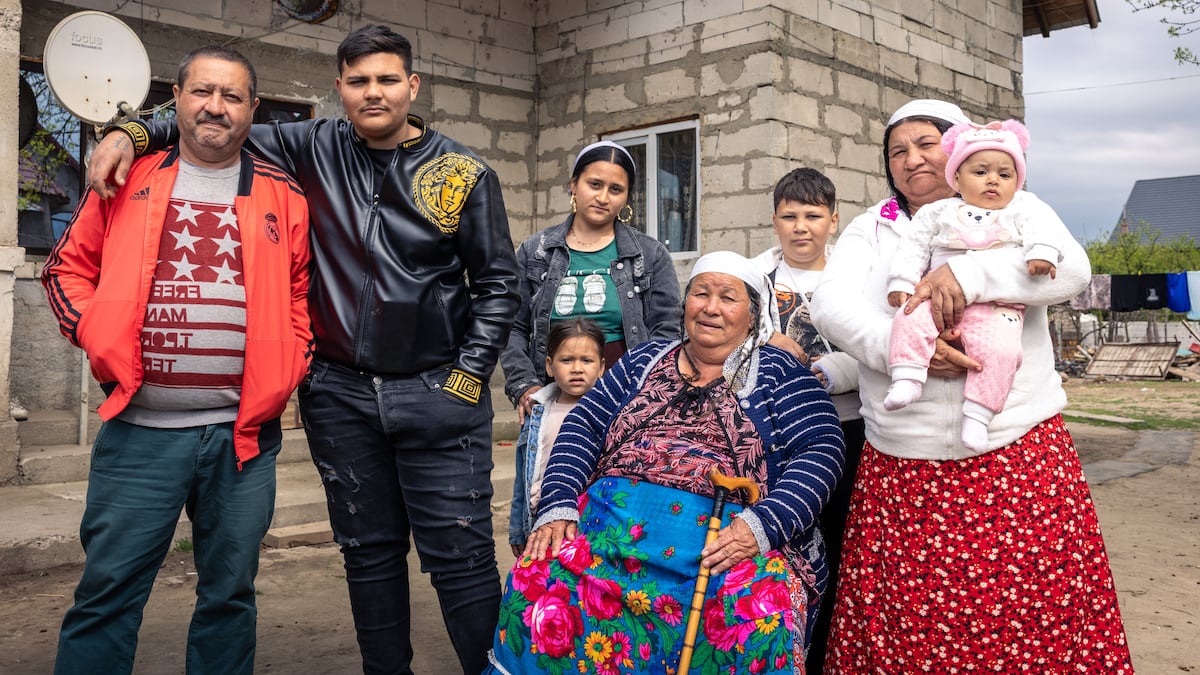
Maria Stanescu was born on the road, nestled at the foot of a cart laden with cauldrons and stills, about 70 years ago. Her childhood was spent as a nomad, immersed in the family business of distilling. Under the vast expanse of the sky, she slept next to a fire that served as both hearth and stove. Despite lacking basic necessities like shoes, Maria experienced a profound sense of freedom. However, thirty years ago, the harshness of winter compelled her family to abandon their nomadic lifestyle and build a home in Fetesti, a village located 145 kilometers east of Bucharest. Following the death of her husband, Maria emerged as the matriarch of a three-generation Roma family, who now gather at the entrance of their home.
Oral Tradition and Historical Trauma
Maria’s legacy is transmitted orally, much like her language, Romani, which remains absent from school curricula. She recounts the years of persecution her family endured, particularly during the regime of Romanian dictator Ion Antonescu, who aligned with Nazi Germany. In 1942, 40 members of her family were forcibly taken to labor camps in the north, many of whom never returned. The genocide of the Roma, which experts estimate claimed between 25% and 50% of the population, remains a largely forgotten chapter in history.
Sociologist Gelu Duminica emphasizes that the Roma people were born into stigma. From their first day of life, they are taught that to succeed, they must be twice as good as their non-Roma counterparts. The Roma’s origins trace back to Punjab, India, from where they migrated in waves, fleeing invasions and poverty. Their entry into Europe began through Romania, where they now represent the largest minority, comprising about 9% of the population.
The Roma Genocide: A Forgotten History
The Roma genocide, known as Samudaripen, has only recently begun to receive acknowledgment, much later than the Jewish Holocaust. Both groups suffered devastating losses during the Nazi extermination, with the Roma identified by a brown triangle armband, a symbol of “undesirables.” They were subjected to mass sterilization campaigns and horrific experiments. It was only a decade ago that the European Parliament officially recognized this genocide, and compensation for descendants of victims has only recently begun in Germany.
Current Demographics and Challenges
Today, the Roma are the largest ethnic minority in Europe, with estimates ranging from 10 to 12 million across the continent. Approximately half of them reside in EU countries, with significant populations in Romania and Spain. Despite some progress in education and healthcare access, systemic poverty remains a significant issue. In Spain, for instance, 80% of Roma are at risk of poverty, compared to 16.8% of non-Roma. Political integration continues to be a major challenge, with no Roma Members of the European Parliament currently serving.
Structural Poverty and Political Representation
The structural poverty faced by Roma communities is stark. Romanian Socialist MEP Victor Negrescu criticizes the lack of a specific EU fund dedicated to Roma inclusion. The situation is particularly dire in countries like the Czech Republic and Slovakia, where legal barriers hinder Roma access to documentation and basic services. Petre-Florin Manole, Romania’s first Roma minister, highlights that even those who escape poverty still grapple with social stigma.
Education and Identity
Education is a crucial factor for political representation. However, the statistics are disheartening: only 0.8% of Roma have university degrees compared to 26% of non-Roma. Trinidad Muñoz Vacas, a university professor in Spain, notes that the first documented reference to Roma dates back to 1425, with subsequent royal decrees aimed at forced assimilation stripping them of their customs and livelihoods.
The Great Roundup: A Historical Tragedy
The Great Roundup of 1749 marked a significant rupture between the Roma and non-Roma populations in Spain. In a single night, thousands of Roma were arrested, separated, and subjected to forced labor, plunging them into poverty and despair. This tragic episode remains largely absent from Spanish history books, with Roma history primarily transmitted through oral traditions.
Resilience and Modern Identity
Despite centuries of persecution, the Roma have demonstrated remarkable resilience. Alina Serban, a Romanian actress, emphasizes that the Roma have only recently begun to define their identity freely. In Spain, a new generation of Roma influencers is emerging, using social media to reclaim their identity and advocate for their rights. Young Roma like Manuel Jiménez and Jr. Yuse are challenging stereotypes and sharing their experiences, highlighting the complexities of life in marginalized communities.
Conclusion
The stories of Maria Stanescu and countless others illustrate the enduring legacy of the Roma people, marked by resilience, cultural richness, and an ongoing struggle for recognition and equality. Their journey from historical persecution to modern advocacy reflects a broader narrative of survival and identity in the face of adversity.