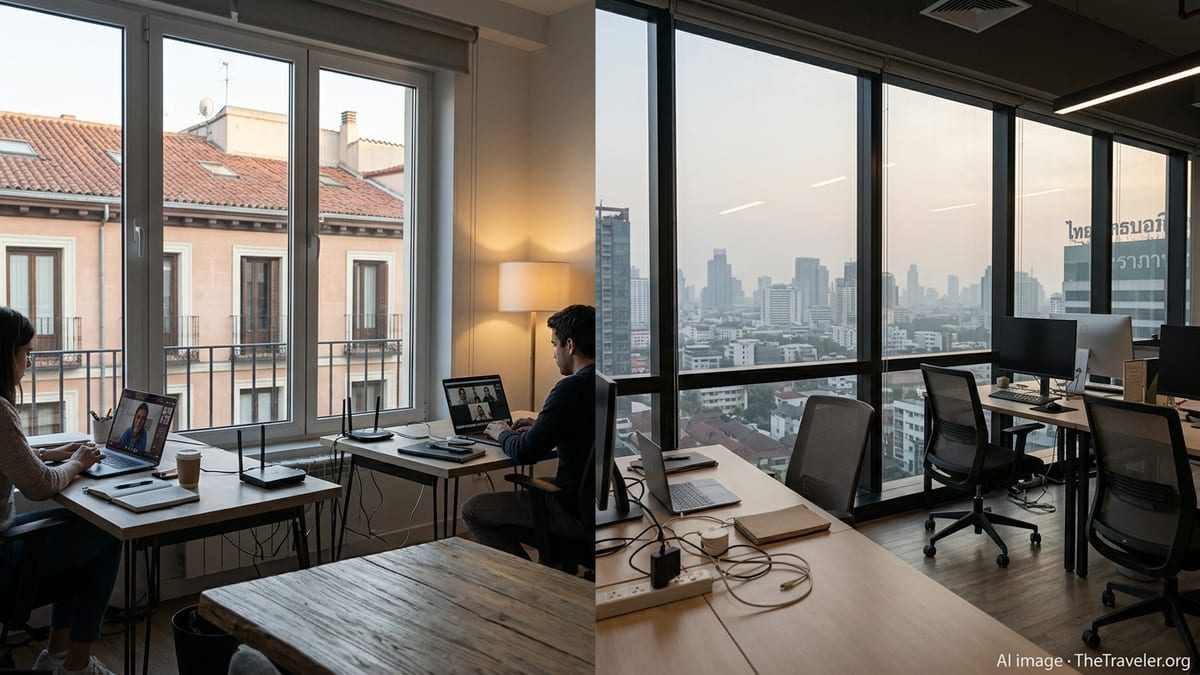
Comparing Spain and Thailand for Remote Work: A Practical Guide
Remote professionals often find themselves at a crossroads when choosing between Spain and Thailand, two vibrant countries that have become popular destinations for digital nomads. While both offer unique experiences, they differ significantly in terms of digital infrastructure, reliability, and overall work environments. This article delves into the practical aspects of remote work in these two countries, helping decision-makers prioritize consistent online performance and professional-grade work conditions.
Framework for Comparing Spain and Thailand for Remote Work
To effectively evaluate Spain and Thailand for remote work, we need to focus on several key criteria: internet speed and reliability, availability of coworking and work-ready housing, time zone alignment with client markets, and operational continuity factors like power stability. Understanding how these elements manifest in each country will provide a clearer picture for remote workers.
Spain benefits from being part of the European Union, which has established advanced digital policies. The country ranks highly in EU indices for digital public services and broadband coverage. A significant portion of fixed broadband subscriptions in Spain offers speeds of 100 Mbps or higher, thanks to a robust fiber rollout and dense urban networks.
On the other hand, Thailand has made substantial investments in mobile networks, particularly in 4G and 5G technologies. While major cities like Bangkok and Chiang Mai boast strong fixed broadband quality, smaller towns and islands may experience variability in service. This difference is crucial for remote workers who rely on consistent connectivity.
Internet Speed, Coverage, and Reliability
Spain’s fixed broadband infrastructure is among the most advanced in Europe. Reports indicate that by 2024, about 70% of fixed broadband subscriptions in Spain will offer speeds of 100 Mbps or higher. Major cities like Madrid, Barcelona, and Valencia frequently advertise residential fiber packages with speeds ranging from several hundred Mbps to 1,000 Mbps.
In contrast, Thailand presents a different landscape. While the country enjoys near-universal 3G and 4G coverage, average national mobile download speeds hover around 40 Mbps, with fixed broadband speeds often in the tens of Mbps range. However, urban centers like Bangkok and Chiang Mai can deliver speeds of 100 Mbps or more, especially in coworking spaces.
Despite these strengths, Thailand’s regional variance can pose challenges. While Bangkok ranks among the top cities globally for internet speed and reliability, smaller towns and islands may experience slower connections and more frequent outages. This makes it essential for remote workers in Thailand to have contingency plans, such as dual internet connections.
Coworking, Coliving, and Work-Ready Spaces
Spain has witnessed a rapid expansion of coworking and flexible office options, particularly since the rise of hybrid work. Major cities like Madrid and Barcelona host hundreds of coworking spaces, equipped with high-speed fiber, meeting rooms, and private call booths. Coastal cities like Valencia and Malaga also feature a growing number of coworking facilities.
In Thailand, the coworking market is highly developed in key remote work destinations. Bangkok, Chiang Mai, and popular islands offer numerous coworking spaces tailored for digital nomads, often featuring ergonomic setups and community events. However, Thailand’s coworking options are more concentrated in a few hubs, while Spain’s offerings are more evenly distributed across the country.
For remote workers who frequently move between cities, Spain provides a more consistent access to structured workspaces. In contrast, Thailand’s coworking scene is robust but limited to specific areas, making it less flexible for those who wish to explore the country.
Power Stability and Business Continuity Risks
A reliable electricity supply is crucial for remote workers who depend on uninterrupted productivity. Spain, as an advanced European economy, generally offers stable grid performance with infrequent outages in urban areas. While short interruptions can occur, they are usually resolved quickly, and many coworking spaces are equipped with backup systems.
Thailand’s situation is more mixed. Major cities like Bangkok experience reasonably reliable electricity, but reports indicate that provincial towns and islands may face more frequent power cuts, particularly during storms or peak demand periods. Many coworking spaces in Thailand mitigate this risk with backup generators, but this is not universal.
For remote workers in Thailand, having a continuity strategy is essential. This may involve selecting buildings with documented backup power, maintaining dual internet connections, and planning fallback options. In Spain, while redundancy planning is still advisable, the overall risk is lower due to more stable infrastructure.
Time Zone Alignment and Communication Windows
Time zone positioning significantly influences communication patterns with clients and employers. Spain operates mainly on Central European Time (UTC+1), which aligns well with the working hours of the European Economic Area. This minimizes the need for early morning or late-night calls for remote workers serving European clients.
Conversely, Thailand operates on Indochina Time (UTC+7), which creates minimal overlap with European business hours. For remote workers with a European client base, this often necessitates asynchronous workflows or acceptance of irregular working hours. However, Thailand’s time zone is advantageous for serving clients in East Asia, Australia, and New Zealand.
Urban vs. Regional Remote Work Environments
In Spain, the remote work experience varies between large metropolitan areas, mid-sized cities, and rural towns. However, the disparities are mostly in lifestyle and cost rather than digital infrastructure. Reports indicate that high-speed broadband is widely available in urban and suburban areas, with smaller cities also having access to fiber connections and coworking facilities.
In Thailand, the differences are more pronounced. Major hubs like Bangkok and Chiang Mai offer excellent internet speed and workspace quality, while more remote areas may struggle with connectivity. For remote workers in Thailand, it’s often practical to anchor in a well-connected hub and treat more remote locations as temporary work-light periods.
FAQ
Q1. Which country generally has more reliable home internet for remote work, Spain or Thailand?
Spain generally offers more uniformly reliable home internet, with a high proportion of subscriptions at or above 100 Mbps, while Thailand’s reliability is excellent in major hubs but more variable in regional areas.
Q2. Are coworking spaces in Spain or Thailand better equipped for high-bandwidth tasks like video production and large file transfers?
Premium coworking spaces in both countries can support high-bandwidth tasks, but Spain’s broader fiber-based infrastructure means such facilities are widely distributed, whereas in Thailand they are concentrated in hubs.
Q3. How do mobile networks compare for working on the move in Spain versus Thailand?
Both countries have strong mobile networks, with Spain offering mature 4G and expanding 5G coverage, and Thailand featuring nationwide 3G and 4G plus growing 5G, though performance in Thailand can drop more noticeably in remote areas.
Q4. For European clients, which country offers more convenient working hours?
Spain aligns much more closely with European business hours, allowing a typical workday with minimal schedule adjustment, whereas Thailand requires either very early starts or late finishes.
Q5. Is it realistic to rely only on a home connection in Thailand without coworking or backup options?
In central Bangkok or well-served districts of Chiang Mai, it can be realistic, but many remote workers still maintain backup mobile hotspots or coworking memberships due to higher outage risk.
Q6. How does power outage frequency affect remote work in Spain and Thailand?
Spain’s major cities experience relatively infrequent and short outages, while parts of Thailand, especially outside major hubs, can see more frequent interruptions, making backup power and flexible work locations more important.
Q7. Which country is better suited for remote workers who move frequently between cities within the country?
Spain is generally better for frequent internal moves, as strong fixed broadband and coworking options are available across a wide range of cities.
Q8. Are upload speeds sufficient for frequent video conferencing in both Spain and Thailand?
In major urban centers and established coworking spaces in both countries, upload speeds are typically sufficient for high-quality video conferencing, but Thailand’s secondary and rural locations may struggle more with consistent upstream capacity.
Q9. Which country offers better infrastructure for fully asynchronous remote work where live meetings are rare?
For fully asynchronous work, both Spain and Thailand can perform well, but Spain offers more uniform reliability, while Thailand can be attractive if the worker is based in a well-connected hub.
Q10. If remote work continuity is critical and downtime must be minimized, which destination is safer overall?
For minimal tolerance to downtime, Spain is generally the safer choice due to more consistent grid stability and nationwide high-speed broadband, while Thailand can work well in selected hubs with careful redundancy planning.