The Tenth Archaeological Campaign at Lobos Islet: Unveiling the Past of the Canary Islands
Introduction to Lobos Islet
Lobos Islet, located off the coast of Fuerteventura, has become a focal point for archaeological research, particularly concerning the Roman presence in the Canary Islands. This small but significant islet, part of La Oliva, continues to reveal its historical secrets, particularly through its famed workshop dedicated to the production of purple dye, a highly prized commodity in ancient times.
A Milestone in Archaeological Research
As the tenth campaign of excavations kicks off, the efforts are framed within a partnership between the Cabildo of Fuerteventura and the Autonomous Organization of Museums and Centers of the Cabildo of Tenerife. This collaboration is part of an expansive research initiative titled “Towards the Definition of the Purple Islands,” which aims to further understand the historical and archaeological significance of the region.
The Team Behind the Excavations
The latest excavation brings together a diverse team of experts—archaeologists, biologists, and various specialists—all unified in their quest to unlock the mysteries of Lobos Islet. Collaborators include members from both Fuerteventura and Tenerife’s archaeological museums and are supported by numerous friends and affiliates eager to contribute to this significant undertaking.
Campaign Schedule and Goals
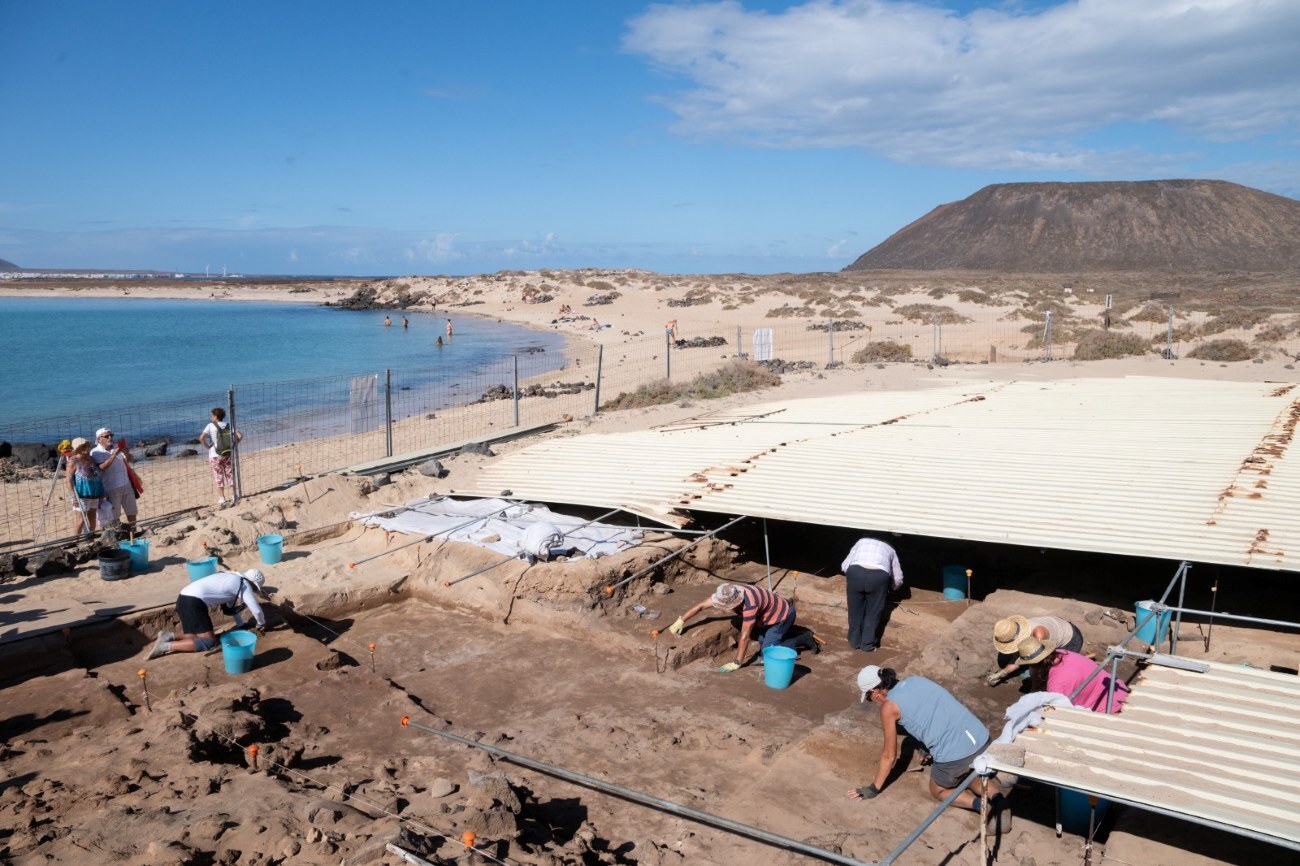
Spanning three weeks, the current campaign is set to conclude on November 15, with a targeted exploration of the Lobos I site. This site is primarily identified as a workshop for purple dye production, and the goal is to assess its extent further south, specifically near the La Calera beach area. To achieve this, two distinct exploratory pits will be excavated: one near the existing workshop, positioned at the base of a small volcanic cone, and another towards the southwest, closer to the coastline.
Potential Discoveries and Their Implications
The areas identified for excavation may highlight distinct activities—one related to everyday life and the other possibly linked to fishing practices. The results from this dig have the potential to provide invaluable insights into the lives of those who inhabited the region during Roman times, as noted by Rayco León, the Heritage Minister, who emphasizes the archaeological significance of this site.
Leadership and Support
The campaign is led by Isidoro Hernández, of the Fuerteventura Archaeological Museum, alongside Carmen del Arco, a prehistorian from the University of La Laguna. The initiative has received authorization from the General Directorate of Culture and Cultural Heritage of the Canary Islands. In addition to local support, BINTER Canarias plays a crucial role by covering transportation costs for the research team and their materials.
A Long-Term Commitment to Research
Since 2012, the research initiative “Towards the Definition of the Purple Islands” has been underway, driven by a partnership between the Cabildo de Fuerteventura and the Autonomous Organization of Museums and Centers of the Cabildo of Tenerife. Spearheaded by experts like Isidoro Hernández and Mercedes del Arco, this ongoing work aims to deepen our understanding of Roman trade and production practices in the Canary Islands.
Significant Findings Over the Years
Past campaigns have unearthed critical evidence of Roman activity in the Canary Islands, specifically dating to the late Republican and early Imperial periods, roughly between the 1st century BC and the 1st century AD. Remarkably, excavations have revealed an array of artifacts, including amphorae, domestic pottery, specialized tools, and even remnants associated with purple dye manufacturing.
Expansion of Excavation Areas
In November 2023, the ninth campaign revealed profound new insights, expanding the excavation site by 370 square meters to the north. The efforts were primarily aimed at validating findings from ground-penetrating radar (GPR) surveys, which had highlighted potential hidden structures beneath the soil. The explorations focus on two main areas: one dedicated to dye production and the other reflecting the daily lives of the inhabitants.
The Influence of Roman Culture
Lobos I stands as a crucial piece in the larger puzzle of Roman influence in the Atlantic, redefining the borders of the Roman Empire and illustrating its economic and cultural impact on the region. Over the last decade, findings from this site have cemented Fuerteventura’s status as a critical location for international scientific research concerning the legendary Purple Islands described in classical literature.
Continuous Exploration
With each excavation campaign, researchers peel back layers of history, uncovering the rich tapestry of life on Lobos Islet. The insights gained not only enrich our understanding of the past but also illuminate the connection between ancient practices and the contemporary world, ensuring that the legacy of these early inhabitants lives on through diligent scholarship and discovery.