Unearthing the Past: The Discovery of a 2,400-Year-Old Bronze Chariot in Spain
Archaeologists in Spain have recently made a remarkable discovery: the remains of a 2,400-year-old bronze chariot, believed to have been used in rituals to honor the gods. This extraordinary find, unearthed at the archaeological site known as Casas del Turuñuelo in Badajoz province, is said to have “no known parallels” in the Iberian Peninsula, according to the research team involved in the excavation.
The Chariot’s Design and Function
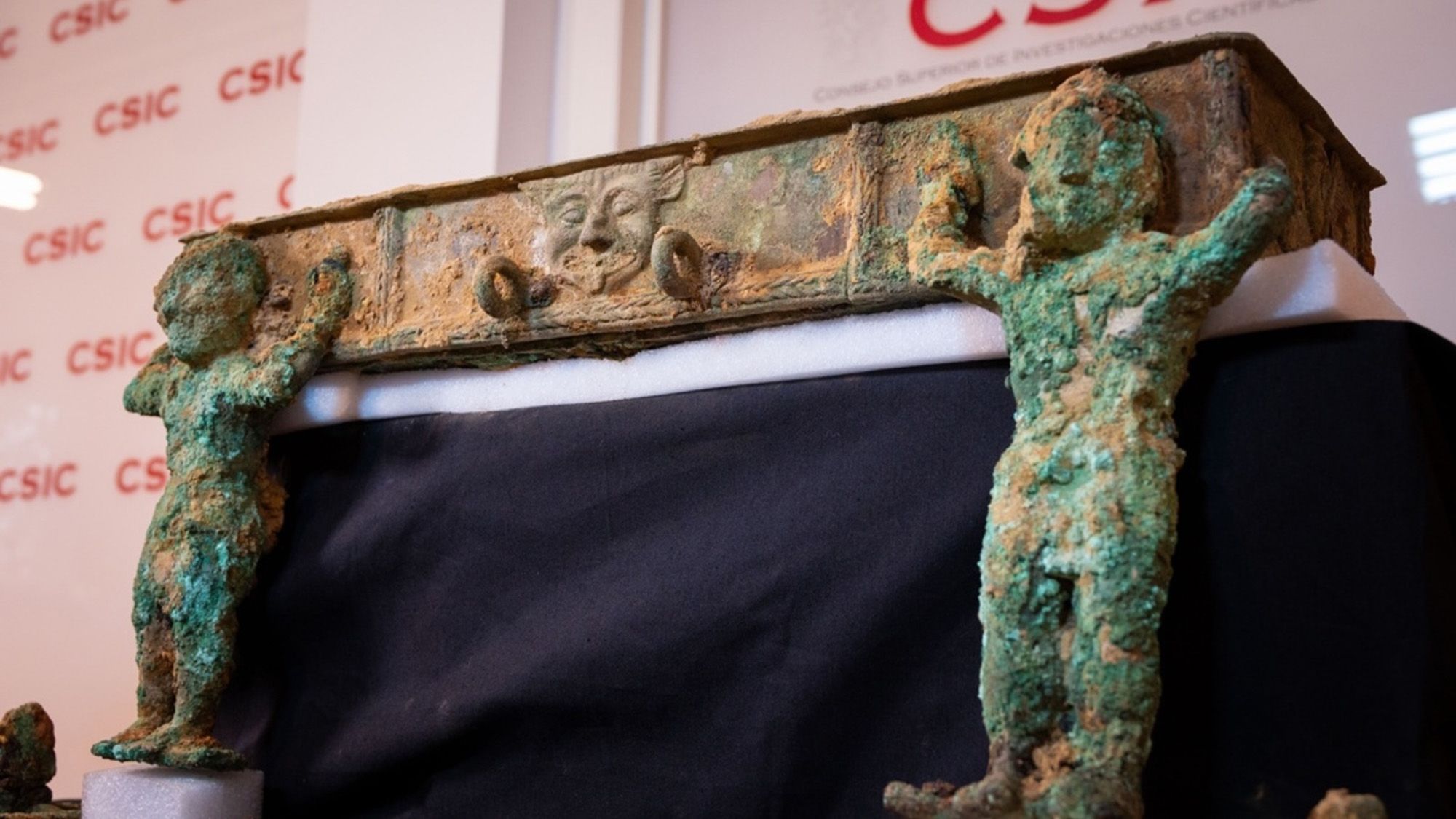
Measuring approximately 24 inches long (60 centimeters), the chariot features a flat, table-like top that likely served as a surface for burning incense as a divine offering. This design suggests that the chariot was not merely a mode of transport but a ceremonial object imbued with spiritual significance. The research team, including archaeologist Guiomar Pulido González from the Mérida Institute of Archaeology, emphasizes the chariot’s unique role in ancient rituals.
Mythical Imagery: A Fusion of Cultures
One of the most striking aspects of the chariot is its intricate decoration. The side of the chariot showcases a face that appears to be a fusion of a gorgon, a protective symbol often associated with Medusa, and Achelous, a river god in Greek mythology who could transform into a bull. This blend of imagery raises intriguing questions about the cultural influences at play during the chariot’s creation. Pulido notes that the figurative elements of the chariot point to protective deities, though the specific purpose of these figures remains uncertain.
The Chariot’s Unique Features
The chariot’s design includes two legs that resemble two people holding up the table portion, a feature that adds a layer of complexity to its interpretation. Interestingly, these figures are depicted wearing skirts, which is atypical for Etruscan bronze figures, which are usually portrayed as naked. This anomaly suggests that the chariot may have been crafted by the Etruscans, a pre-Roman civilization from Italy, and transported to Spain through ancient trade routes.
Archaeological Context: A Layer of History
The chariot was discovered in a layer of soil indicating it was discarded around the end of the fifth century B.C. However, the iconography of the gorgon-Achelous face suggests it could have been created as early as the sixth century B.C. This timeline places the chariot within a broader historical context, linking it to the Etruscans and their influence on the Iberian Peninsula.
The Enigmatic People of the Guadiana Valley
The archaeological site of Casas del Turuñuelo is located in the Middle Guadiana River Valley, an area rich in history but shrouded in mystery. This region is home to 14 known sites associated with a culture that seemingly vanished from the archaeological record around 400 B.C. Pulido speculates that these sites may have belonged to local populations heavily influenced by the Tartessians, a civilization known for its elaborate writing system and trade networks.
Ritualistic Closure: A Symbolic Farewell
The recent findings suggest that the inhabitants of these sites may have engaged in a ritualistic closure, intentionally burning their buildings and filling them with soil and fragmented objects. This act of decommissioning appears too deliberate to have been the result of an enemy attack, indicating a carefully planned farewell to their structures.
Trade Networks and Cultural Exchange
Despite their disappearance, evidence such as imported pottery from Greece and other Etruscan bronze artifacts suggests that the people of the Guadiana Valley were active participants in ancient Mediterranean trade networks. Their elite likely possessed the wealth to acquire imported goods, hinting at a complex society with connections beyond their immediate environment.
The Chariot’s Legacy
As researchers continue to study the bronze chariot and its context, it stands as a testament to the rich tapestry of cultural exchange and ritual practices in ancient Iberia. The discovery not only sheds light on the Etruscans’ influence but also invites further exploration into the enigmatic people who once inhabited the Middle Guadiana River Valley. Each artifact unearthed adds another layer to our understanding of a time long past, reminding us of the intricate connections that have shaped human history.