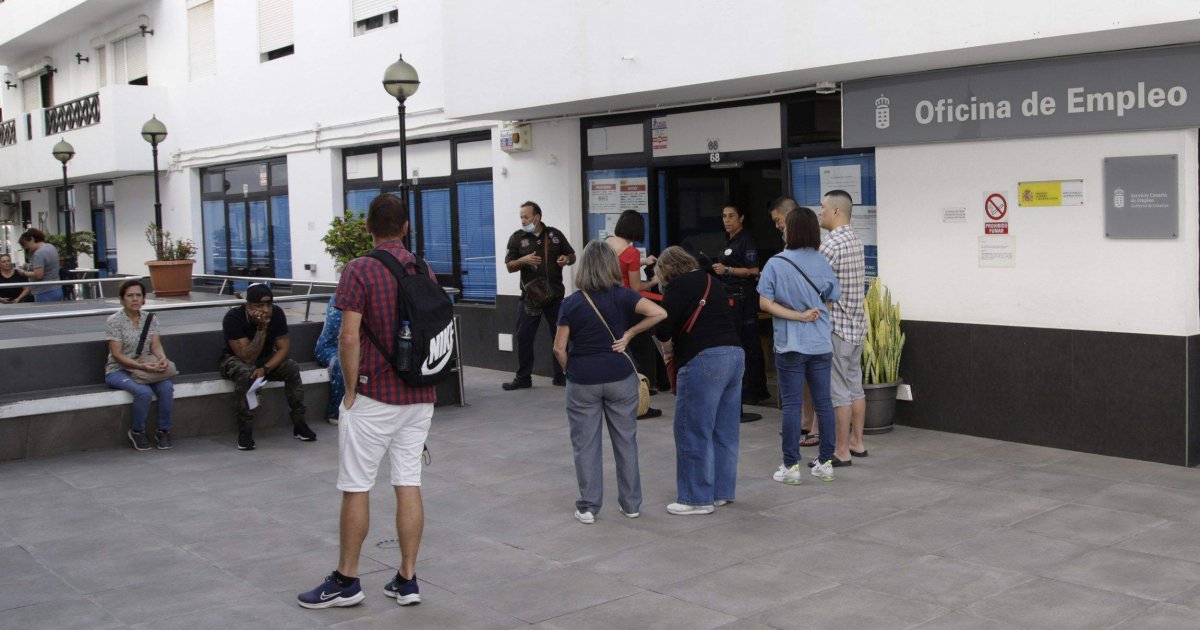
Unemployment Trends on Lanzarote: A Closer Look
Recent Statistics
In March, Lanzarote experienced a slight uptick in unemployment, with a 0.4% increase translating to 25 additional individuals joining the unemployment ranks. This brings the total number of unemployed residents on the island to 6,780, according to the latest figures from the Canarian Employment Observatory (Obecan). While this may seem concerning, it’s important to note that compared to the same period last year, unemployment has actually decreased by 7.9%, equating to approximately 600 fewer job seekers.
Broader Context in the Canary Islands
When we expand our view to the entire Canary Islands, the situation presents a mixed picture. In March, registered unemployment across the archipelago rose by 843 individuals, marking a 0.58% increase from February. This brings the total number of unemployed in the region to 146,499. The overall job-seeking population in the Canary Islands stands at 214,661, which includes not only the unemployed but also those seeking employment under special conditions.
Breakdown of Job Seekers
Among the job seekers, 36,637 individuals are currently employed, while 21,822 are job seekers with special working conditions. The most notable increase in unemployment occurred within the group of unemployed job seekers, which grew by 1,293 people, or 0.83%, in March. This group is a significant focus for policymakers, as it includes the 146,499 unemployed counted at the end of March.
Island-Specific Trends
Diving deeper into the island-specific data, we see varying trends. In Tenerife, unemployment rose by 0.9%, while Gran Canaria saw a 0.5% increase. Conversely, La Palma and Fuerteventura reported declines in unemployment, with La Palma experiencing a notable drop of 1.4% and Fuerteventura a slight decrease of 0.1%. These fluctuations highlight the diverse economic conditions across the islands, suggesting that local factors may be influencing employment rates differently.
Year-on-Year Comparisons
Looking at the year-on-year data, the Canary Islands have seen a significant reduction in unemployment, with a decrease of 10,929 individuals, or 6.94%, over the past twelve months. This trend is encouraging and indicates that, despite the recent monthly increases, the overall trajectory for employment in the region is positive.
National Context
On a national scale, the Canary Islands recorded the largest monthly rise in unemployment in Spain for March, particularly affecting the western province. This area added 514 unemployed individuals, a 0.73% increase compared to February, bringing the total number of unemployed in that province to 71,048 by the end of March. This national context underscores the unique challenges faced by the Canary Islands, which often experience economic fluctuations tied to tourism and seasonal employment.
Conclusion
The employment landscape in Lanzarote and the broader Canary Islands is complex, marked by both challenges and improvements. While March brought a slight increase in unemployment, the year-on-year decline offers a glimmer of hope. As the islands navigate these economic waters, understanding the nuances of unemployment trends will be crucial for residents, policymakers, and stakeholders alike.

![[gpt_title] Rewrite this article’s title in the tone of *Fuerteventura Times* — calm, intelligent, and curiosity-driven. Keep it under 60 characters. Focus on themes like consciousness, healing, creativity, or neuroscience — avoid hype or clickbait. Make it sound soulful yet journalistic. Examples: “The Science of Stillness,” “Microdosing for Meaning,” “A New Age of Conscious Healing.” [/gpt_title]](https://www.oakland.edu/media/Oakland/Assets/OUWB/images/news/2026/040626-PlantPlunge1.jpg "[gpt_title] Rewrite this article’s title in the tone of *Fuerteventura Times* — calm, intelligent, and curiosity-driven. Keep it under 60 characters. Focus on themes like consciousness, healing, creativity, or neuroscience — avoid hype or clickbait. Make it sound soulful yet journalistic. Examples: “The Science of Stillness,” “Microdosing for Meaning,” “A New Age of Conscious Healing.” [/gpt_title]")
