La Bocaina: The Cultural and Historical Heartbeat of Lanzarote and Fuerteventura
A Gateway Between Two Worlds
Every week, the vast waters of La Bocaina see thousands of tourists and residents crossing its waves to travel between Lanzarote and Fuerteventura. This grand arm of the sea is more than just a busy thoroughfare for tourism, trade, and transportation; it is also a region steeped in cultural and historical significance that often goes unnoticed.
The Historical Tapestry of La Bocaina
The narrow strait of La Bocaina has been witness to significant events throughout the ages. From the arrival of the first inhabitants to the modern-day economies that thrive here, the area has seen centuries of conquest, piracy, traditional agriculture, and fishing. Its rich history serves as a testament to the resilience and evolution of the communities that call these islands home.
Geological Significance
La Bocaina stands as a geological testament to the connection between Lanzarote and Fuerteventura. All the Canary Islands are volcanic in origin; however, Lanzarote and Fuerteventura, along with their smaller islets, are part of a single underwater construct, leading some geologists to refer to them collectively as the Isla de Mahan. This unique geographical union lends La Bocaina its importance, especially since it forms the largest landmass in the archipelago when viewed in context with the other islands.
This “submarine corridor” between Fuerteventura, Lanzarote, and La Graciosa affects marine life in compelling ways. The underwater platform that connects these islands supports a rich biodiversity that transcends administrative boundaries, showcasing the interconnectedness of their ecosystems.
An Ancient Valley
During glacial periods, approximately 20,000 years ago, La Bocaina resembled a vast valley, walkable by our prehistoric ancestors due to significantly lower sea levels. The emergence of land in what is now central Fuerteventura occurred around 18 million years ago, gradually expanding in various phases. Yet, this connection is dynamic; La Bocaina has been redefined over time by geological events, such as the eruption of the Montaña Roja at Playa Blanca and the volcanic series of Bayuyo in northern Fuerteventura, approximately 135,000 years ago.

Map of La Bocaina created by Leonardo Torriani in the 16th century.
Archaeological Treasures
The geographic features of La Bocaina have historically made it a focal point for settlements, given the presence of freshwater wells and a cornucopia of marine resources, including fish, shellfish, and birds. The area is home to significant archaeological sites, such as the Cueva del Llano and Cueva de Villaverde in Fuerteventura, and crucial sites on the Lanzarote side, like Isla de Lobos and Rubicón.
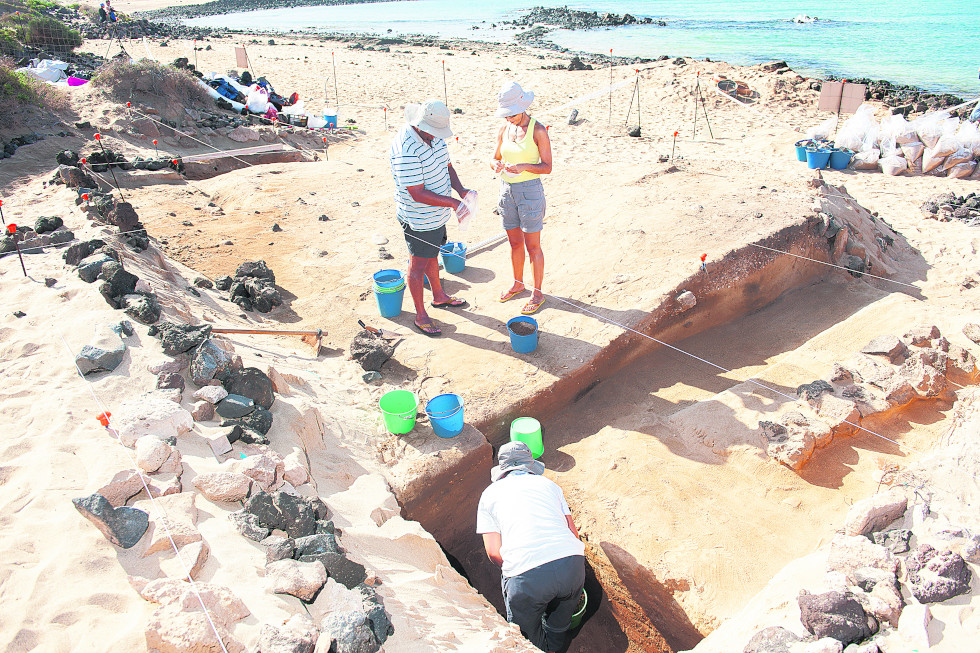
A fortuitous discovery in 2012 by tourists at La Calera beach on Isla de Lobos unveiled evidence of a Roman-era purple dye extraction workshop, shedding light on the ancient world’s commerce and industry. This site, prominently featuring the carnation shell (Stramonina haemastoma), produced the highly sought-after purple dye valued in Roman society.
San Marcial del Rubicón: A Historical Crossroads
Another critical archaeological site lies within the bay at Lanzarote, San Marcial del Rubicón. This settlement marks the first European establishment in the Canary Islands, initiated by the Norsemen Jean de Bethencourt and Gadifer de La Salle in 1402. The fortifications and wells there not only represent a pivotal moment in the islands’ colonial history but also provide insights into the complex interactions between European settlers and the indigenous majos.
Recent excavations from 2019 to 2023 have revealed a mix of human remains, including both Europeans and native islanders, deepening our understanding of historical coexistence in this area.

Corralejo Pier in 1969. Image courtesy of the Historical Photography Archive of the Canary Islands.
A Legacy Shaped by Conflict and Tradition
The shores of La Bocaina have also been influenced by piracy and privateering, with notable structures like the Castillo de Las Coloradas and the Torre del Tostón bearing witness to these turbulent times. Despite the initial aridity of southern Lanzarote and northern Fuerteventura, small settlements formed, primarily driven by the bountiful ocean resources available along La Bocaina’s coastline.
This rich marine bounty has fostered a fishing tradition that has persisted through the centuries, with locations like Corralejo, Playa Blanca, and El Cotillo serving as hubs for maritime activity since the period of European conquest. As communities built their livelihoods on the sea, maritime carpentry skills flourished, particularly enhancing fishing practices.
Cultural Heritage and Architecture
The area surrounding La Bocaina is a treasure trove of traditional architecture, evidenced by numerous examples of ingeniously designed water management structures such as wells, cisterns, and irrigation systems. Additionally, the agricultural landscapes showcase unique constructions like barrilla ovens and various types of windmills, highlighting the region’s historical role as the “granary of the Canaries.”
The coastal views are marked by impressive 19th-century lighthouses, including the Martiño lighthouse on Isla de Lobos and the Pechiguera lighthouse at Playa Blanca, standing as sentinels of the maritime history that envelops La Bocaina.

Vintage postcard of Commercial Silva from the 1960s, depicting Isla de Lobos and the Corralejo dunes before hotel developments.
Tourism and Transformation
The second half of the 20th century brought dramatic changes to La Bocaina, as tourism emerged as a vital economic engine. Once sparsely populated, the area has transformed into a bustling nexus of activity, with Playa Blanca and Corralejo now being two of the most prominent urban centers in the Canaries.
Tourists flock to these regions not only for their stunning vistas but also to experience the cultural and natural heritage that La Bocaina offers. Guides often convey that Timanfaya National Park presents the best excursions for those visiting Fuerteventura, while the Dunes of Corralejo are hailed as a must-visit beach for Lanzarote travelers.
Each time visitors traverse La Bocaina’s waters, they are not just crossing a physical divide; they are navigating through layers of history intertwined with the present landscape—geology, archaeology, architectural marvels, and maritime lore all coalesce in this stunning strait.