Transparency Insights into Majorero Town Halls: An Annual Evaluation
The recent Annual Evaluation Report on Compliance with the Transparency Law of the Canary Islands for 2022 and 2023 has shed light on the performance of various town halls in Fuerteventura, specifically highlighting their transparency scores. This evaluation provides a critical look at how these local governments are handling accountability and openness, which are essential for fostering trust within their communities.
Antigua: A Struggle for Transparency
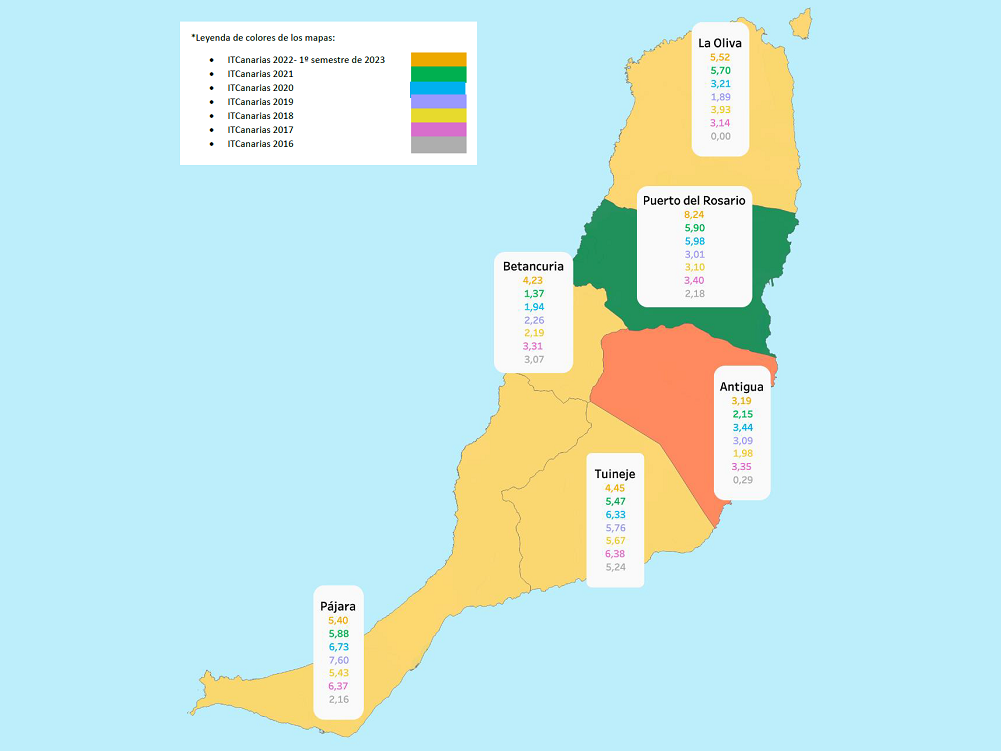
At the bottom of the spectrum, the Antigua Town Hall received a score of 3.19, marking it as the least transparent among the Majorero town halls. While this score reflects a concerning lack of transparency, it is essential to recognize the progress made since 2016, when the municipality scored a mere 0.29. This notable improvement indicates a conscious effort towards enhancing transparency, even if the current score remains disappointing. In addition to the town hall itself, the mixed company Aguas de Antigua S.L. garnered a score of 2.15, further affecting the public sector’s average score, which landed at 2.67.
Betancuria: Gradual Progress
The Betancuria Town Hall stands next on the list, recording a score of 4.23. Though still below the passing mark, this represents significant growth for the municipality, which has been on an upward trajectory, increasing more than a point since 2016. This progress demonstrates a shift in commitment to adhering to transparency principles—even if the journey is still far from complete.
Tuineje: A Decline in Scores
Contrasting with Betancuria’s upward trend, the Tuineje Town Hall witnessed a downturn, scoring only 4.45. The situation is particularly alarming as it has decreased from 5.24 in 2016, suggesting a regression rather than advancement in transparency efforts. This decline calls into question the future of transparency initiatives within the municipality.
Pájara: Striking a Balance
In a somewhat mixed picture, the Pájara Town Hall achieved a score of 5.4, technically passing the threshold for transparency. However, the story doesn’t end there. The performance of the associated autonomous local body, Escuelas Infantiles de Pájara, was notably poor, scoring only 2.63. This disparity highlights a critical issue where a town hall may be performing well overall, but associated entities can significantly impact the overall perception of transparency.
La Oliva: Close to Passing
The La Oliva Town Hall managed to scrape through with a score just over the passing line at 5.52. However, a poor performance from its subsidiary company, Suministro Aguas La Oliva S.L., which scored only 1.65, brought down the average score for the public sector attached to this municipality to 3.59. Clearly, the interconnectedness of these entities necessitates a holistic approach to transparency.
Puerto del Rosario: Setting New Standards
On a much brighter note, the Puerto del Rosario Town Hall has set a benchmark with an impressive score of 8.24, categorizing it as notably transparent. This marks a remarkable turnaround from its earlier score of 2.18 in 2016, highlighting substantial improvements in governance and transparency practices. Puerto del Rosario serves as a model for other municipalities, showcasing how dedicated efforts can lead to significant advancements in public transparency.
Conclusion
The transparency scores of Majorero town halls present a compelling overview of the current state of local governance in Fuerteventura. While some municipalities show promising trends, others indicate a critical need for improvement. The emphasis on transparency remains vital in nurturing public trust and accountability, paving the way for more engaged and informed communities.