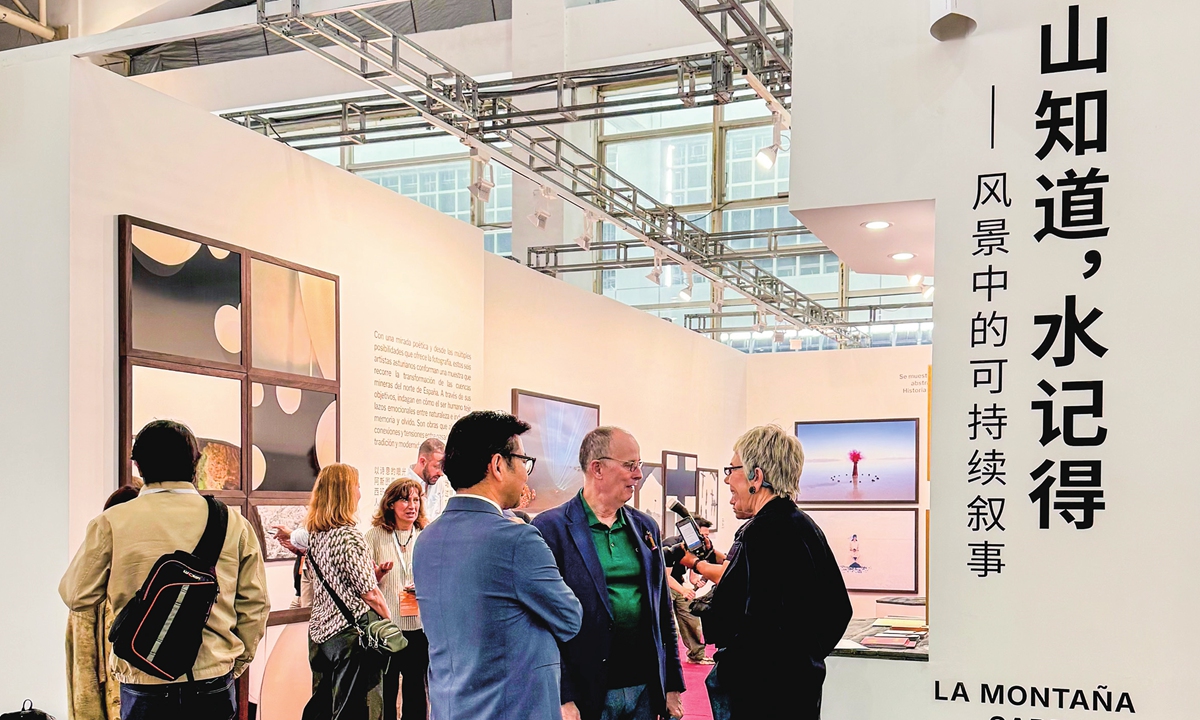
Visitors explore works at the booth of the Cervantes Institute in Beijing on May 21, 2026. Photo: Dong Feng/GT
The 2026 Beijing Dangdai Art Fair, held at the National Agricultural Exhibition Center, is a vibrant celebration of contemporary art, running from Thursday to Sunday under the evocative theme of “Land Trace.” This year marks a significant milestone as the Cervantes Institute in Beijing, a prominent Spanish public institution dedicated to promoting the Spanish language and Latin American culture, makes its debut at the fair.
Inma González Puy, the director of the Cervantes Institute in Beijing, expressed excitement about this new venture, emphasizing that the institute’s participation reinforces its commitment to fostering dialogue between Chinese and Latin American cultures. The fair serves as a platform to showcase the artistic voice of northern Spain, allowing visitors to engage with a rich tapestry of cultural narratives.
The theme “Land Trace” encapsulates the historical evolution and the shifting landscapes that define our world. It invites attendees to reflect on the paths we walk through urban streets and alleys, symbolizing the deep connections between people and their environments. This theme resonates with the current global discourse on sustainability and environmental consciousness, making it particularly relevant in today’s context.
The Cervantes Institute’s booth, titled La montaña sabe, el agua recuerda: narrativas sostenibles en el paisaje (The mountain knows, the water remembers: sustainable narratives in the landscape), features the works of six Asturian artists. These artists explore the profound relationship between humanity and the land through various artistic forms. The exhibition, curated by Laila Bermúdez and Ramón Isidoro, weaves together narratives of memory, sustainability, and landscape change, prompting viewers to contemplate the evolving nature of their surroundings.
Asturias, located along the northern coast of Spain, is steeped in history and culture. Bermúdez highlights the region’s unique characteristics, from its mountainous terrain to its lush greenery. Once a thriving mining area, Asturias has undergone significant transformation since the 1920s, with many mines now abandoned. This deindustrialization has given rise to a new artistic perspective, allowing photographers and artists to capture the area’s beauty and history through a more poetic lens.
Bermúdez hopes that the artworks will transcend language barriers, connecting with Chinese visitors on a deeper level. She notes that the shared visual language between Chinese and Spanish artists is particularly evident at the fair, allowing for a rich exchange of ideas and perspectives. “Chinese artists’ works could be more concrete to be understood,” she remarked, emphasizing the importance of visual storytelling in bridging cultural divides.
In the context of growing global concerns about climate change and sustainable development, the artistic practices showcased at the fair encourage the public to rethink their relationship with resources and the environment. González Puy points out that these works guide audiences toward considerations of resource recycling, material regeneration, and the balance between tradition and modernity.
Moreover, the Cervantes Institute’s participation in the art fair aims to promote sustainable cultural exchange among China, Spain, and Latin America. These regions face similar challenges in urban development, ecological protection, and cultural transformation. Art serves as a powerful tool for fostering international dialogue, transcending geographical and cultural boundaries, and nurturing a deeper understanding and cooperation centered on shared goals of sustainability and historical memory.
This year’s art fair is set to expand its reach, featuring over 20 countries, 45 cities, and 130 exhibitors. The event’s evolution mirrors that of its host city, intertwining with the broader art ecosystem and reflecting the dynamic nature of contemporary artistic expression. As visitors explore the diverse offerings, they are invited to engage with the narratives that shape our world, fostering a sense of connection and shared responsibility for the future.