Excavating History: The Eighth Archaeological Campaign at the Roman Purple Workshop of Lobos 1
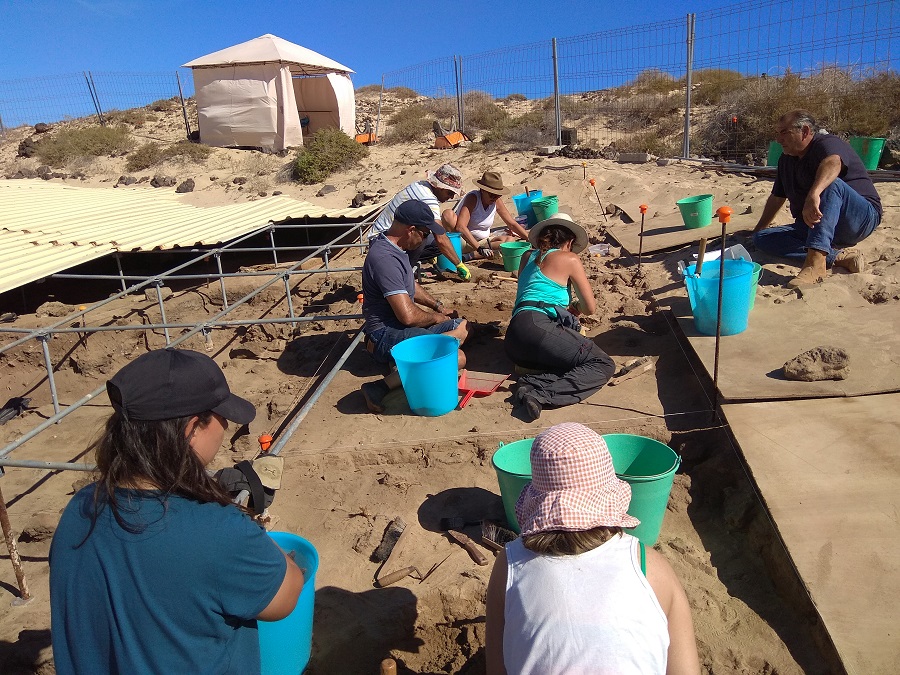
In November, the eighth season of archaeological excavations was successfully carried out at the Roman purple dye workshop of Lobos 1, situated on the picturesque La Calera beach in the Lobos islet. This fascinating project continues to shed light on ancient production practices, particularly surrounding the dye industry, which was an essential part of the Roman economy.
Coordinated Efforts and Interinstitutional Collaboration
The excavation efforts are part of an interinstitutional research project spearheaded by a collaborative team comprising Isidoro Hernández Sánchez from the Archaeological Museum of Fuerteventura, Mercedes del Arco Aguilar from the Archaeological Museum of Tenerife, and Carmen del Arco Aguilar from the Department of Geography and History at the University of La Laguna. Each brings their expertise, ensuring a comprehensive approach to the archaeological work conducted at this notable site. The interdisciplinary team includes researchers and staff from various museums, the Canarian Institute of Bioanthropology, and conservation departments, creating a rich environment for exploration and discovery.
This ambitious project is made possible through a partnership agreement between the Fuerteventura Island Council and the Autonomous Organism of Museums and Centers of the Tenerife Island Council. Additionally, the airline company BINTER has played a vital role by facilitating the transportation of team members and archaeological materials. Furthermore, this year, support from the Directorate General of Cultural Heritage of the Government of the Canary Islands has bolstered the campaign’s success.
Uncovering the Roman Dyeing Practices
The Lobos 1 site dates back to the late Republican and early Imperial periods and represents a specialized workshop focused on the exploitation of marine shells from the muricid family, primarily the Stramonita haemastoma and, to a lesser extent, Hexaplex duplex. The remains of these mollusks provide critical insights into the technological processes involved in the extraction of purple dye—a luxury commodity that drove significant economic benefits in ancient Rome.
Excavation works paid particular attention to an area of 38 square meters in the southern region of the site, revealing a landslide of volcanic stones that disrupted archaeological layers. The findings, consisting predominantly of Roman materials, included new finds of muricid shell middens related to anvils and lithic hammers, as well as combustion structures capable of significant heat production. This suggests that close to the middens, cooking activities were likely undertaken to extract the dye precursor from the hypobranchial glands of the mollusks, with waste products being discarded in the vicinity.
Animal Remains and Daily Life
The excavation site also functions as a refuse area, yielding a plethora of terrestrial faunal remains, particularly of sheep and goats. Skeletal remains often show signs of butchering, hinting at the preparation of meat for sustenance, while fish remains abound, indicating a diverse diet. Notably, artifacts such as turtle shell plates and teeth from sea lions were also uncovered, enhancing our understanding of the local ecosystem and human interactions with it.
The array of artifacts continues to surprise researchers, with various ceramic types—ranging from amphorae and common pottery to fine wares and black-gloss ceramics— being unearthed. Metal instruments, including copper-based hooks and rods and iron nails, were found among the clay remnants. Particularly intriguing was the identification of components potentially related to clavi caligarii, or sandal nails, linking everyday life and dress in Roman society to the larger picture of production and trade.
Technological Advancements in Archaeology
In tandem with excavation, a georadar survey was conducted with the assistance of Pablo Atoche’s research team from the University of Las Palmas in Gran Canaria, supported by geographers Antonio Bueno and Claudio Moreno. This geophysical survey enabled the detection of subsurface anomalies, suggesting the historical depth of habitation in areas now obscured by sand. The hope is that these findings will pave the way for extended archaeological inquiries in future campaigns, offering tantalizing prospects for uncovering further unknown structures or artifacts.
Acknowledgments for Collaborative Efforts
None of this would have been possible without the collective efforts of the numerous institutions involved, the dedicated team of technicians, surveyors, archaeologists, biologists, geographers, and workers all contributing to the campaign. Their hard work and collaboration have yielded significant advancements in our understanding of this vital aspect of Roman economic life.
As excavations continue, they promise to enrich the stories of past civilizations, allowing us to connect with the profound legacy of the ancient world uncovered in this captivating locale.