Nearly Half of Residents in Studied Cities Meet the Three-Tree Visibility Criterion
Recent research by Konijnendijk (2023) emphasizes the importance of urban greenery, proposing that every resident should ideally have a view of at least three trees from their home, school, or workplace. This concept, part of the 3-30-300 rule, aims to enhance the quality of urban life by ensuring access to nature. However, measuring tree visibility presents challenges. Different studies have employed various methods, including surveys, window-view analyses, and computer vision techniques to assess how many trees are visible from residential areas.
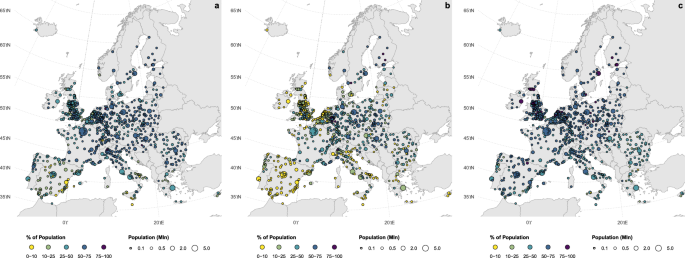
In our study, we utilized viewshed analysis to determine the visibility of three trees from specific observation points, taking into account obstructions like buildings and terrain. By integrating this data with high-resolution tree count information, we were able to estimate that approximately 46.7% of the urban population in the analyzed cities can see at least three trees. Notably, cities such as Lugano (Switzerland), Espoo (Finland), and Berlin (Germany) boast over 70% of residents meeting this criterion. Conversely, cities like Murcia (Spain) and Valletta (Malta) show significantly lower compliance, with fewer than 10% of residents able to view three trees.
One-Quarter of the Analyzed Population Lives in Areas with 30% Tree Cover
The second criterion of the 3-30-300 rule assesses the proportion of the urban population residing in neighborhoods with over 30% tree cover. Our analysis reveals that, on average, only about 28% of the population in the studied cities lives in such green neighborhoods. This rule exhibits the largest variability, with northern and eastern European cities generally faring better. For instance, over 70% of residents in cities like Berlin and Stockholm live in areas with high tree cover. In contrast, many cities in southern Europe struggle, with some having less than 10% of their populations in green neighborhoods.
Interestingly, cities with high tree cover density, such as Savona (Italy) and Baia Mare (Romania), still have low compliance rates due to uneven distribution of green spaces. This highlights the importance of not just having green areas but ensuring they are accessible to residents.
Over Half of Residents in Analyzed Cities Live Within 300 Meters of a Park
The third criterion evaluates the accessibility of parks and green spaces, specifically whether residents live within 300 meters of such areas. Our findings indicate that 57% of urban dwellers in the studied cities can access a green space within this distance, making this criterion the most fulfilled of the three. However, geographical disparities exist. In northern cities like Stockholm and Helsinki, over 75% of residents live near green spaces, while southern cities often report much lower access rates.
Less Than 15% of the Population in Analyzed Cities Fulfills the 3-30-300 Rule
Despite individual successes in meeting the three criteria, overall compliance with the 3-30-300 rule remains low. Only 13.5% of residents across the analyzed cities meet all three criteria. Cities like Espoo and Varese stand out, with over 50% of their populations fulfilling the rule. However, many cities, particularly in southern Europe, struggle significantly, with some areas showing less than 1% compliance.
Wealth Influences Access to Urban Greenery
The distribution of urban green spaces is often inequitable, with wealthier cities providing more access to greenery. Our analysis shows a clear correlation between per-capita GDP and the availability of green spaces. Cities in northern Europe tend to have better access compared to those in the south. Additionally, humidity levels also play a role; cities with higher humidity generally offer more green spaces, further enhancing adherence to the 3-30-300 rule.
Opportunities for Urban Green Space Development
As urbanization continues to rise, the challenge of maintaining and expanding green spaces becomes increasingly critical. The last decade has seen significant urban population growth in Europe, yet this has not been matched by an increase in green areas. Nearly 90% of the population in the studied cities lives within 1 kilometer of a park, suggesting that strategic planning can further enhance access to green spaces.
One promising approach is the concept of the 15-minute city, where essential services and amenities are accessible within a short walk or bike ride. This model encourages sustainable transport modes, reducing reliance on cars and freeing up space for parks and green areas.
Methodological Considerations
While our findings provide valuable insights, they should be interpreted with caution due to several methodological limitations. For instance, the assessment of tree visibility was conducted at a broader scale, which may overlook micro-scale nuances. Additionally, the lack of standardized definitions for neighborhoods complicates the analysis of tree cover compliance.
Despite these challenges, our study represents a significant step forward in mapping the 3-30-300 rule across a large number of cities in Europe. It underscores the urgent need for a green transition that enhances urban livability and ensures equitable access to green infrastructure. By leveraging our findings, policymakers and urban planners can better assess current conditions and develop strategies to improve access to urban green spaces for all residents.

